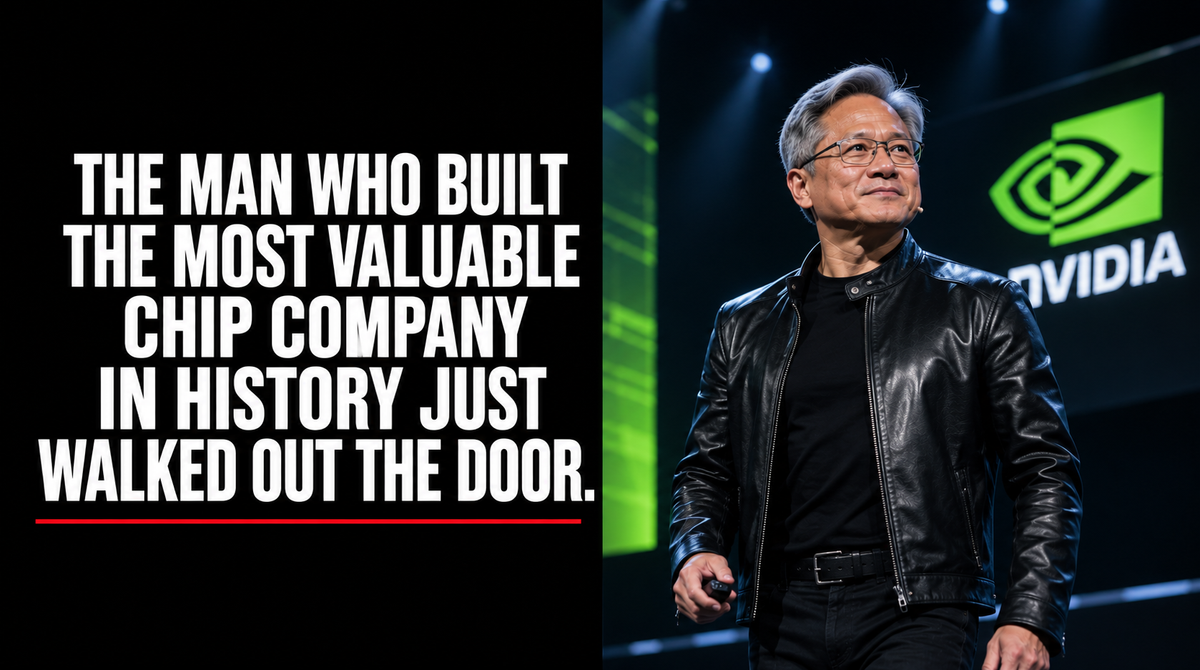
The man who built the most valuable chip company in history just walked out the door.
The Fiduciary Archive · November 12, 2026 · Market Dispatch
Jensen Huang Has Resigned. Nvidia Fell 10%. Every Index Fund in America Felt It This Morning.
After 33 years, the man who built the most valuable semiconductor company in history is gone. CFO Colette Kress will serve as interim CEO. The market’s response was immediate and unambiguous.
By Julian Alden · The Fiduciary Archive · November 12, 2026
Jensen Huang founded Nvidia in 1993. He ran it for thirty-three years. He turned a graphics chip company into the central infrastructure of the artificial intelligence era — a company whose hardware now underlies virtually every significant AI development happening on earth. This morning, he resigned as CEO, effective immediately. CFO Colette Kress will serve as interim chief executive while the board conducts a search for a permanent replacement. Nvidia shares fell more than 10% on the news. That decline, applied to a company of Nvidia’s size and index weight, did not stay inside Nvidia’s ticker. It moved into every S&P 500 fund, every Nasdaq ETF, and every retirement account that holds a broad market index — which is to say, the savings of most Americans who invest.
The Archive’s practice is to separate what we know from what we do not know. What we know is that Jensen Huang’s departure is the single most significant CEO transition in the technology sector in at least a decade. What we do not know is why it happened, what the board’s selection criteria for a permanent replacement will be, or whether the AI infrastructure buildout that made Nvidia the most valuable semiconductor company in history is affected by the change in leadership. These are not small unknowns. They are the questions that will determine whether today’s 10% decline is the floor or the beginning of a longer reassessment.
The 10% decline is not, by itself, an irrational response. Jensen Huang was not a typical CEO. He was the architect of Nvidia’s technical strategy, the person who made the decision to pursue CUDA as a general-purpose computing platform in 2006 — a decision that looked eccentric at the time and looks prescient in retrospect. He was the person who saw the AI inflection before the AI inflection was consensus. When a company’s competitive advantage is substantially embedded in a founder’s judgment about where to allocate R&D capital a decade in advance, the departure of that founder creates a valuation question that the market is correct to ask. The 10% move is the market asking it.
Did China just fire shots at America?
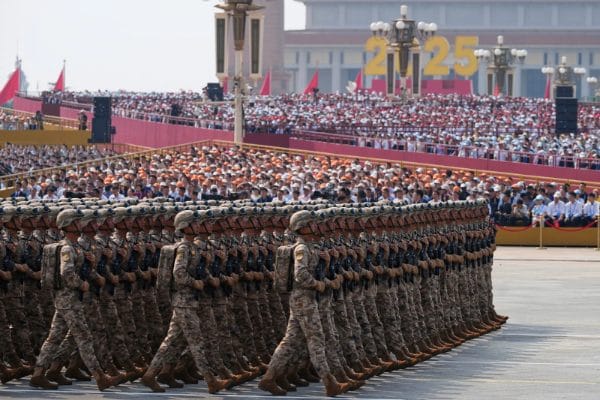
Last week, in Tiananmen Square, China put on a chilling display of military power.
Fighter jets, tanks, AI-guided drones — all paraded under the red flag, in front of Vladimir Putin, Kim Jong Un, and more than two dozen world leaders.
|
Meanwhile, in Washington, President Trump watched.
“They were hoping I was watching,” he said. “And I was watching.”
But what he didn’t say matters more. Because while the media calls it a “celebration,” those of us paying attention know what it really was: a warning shot at America. A not-so-subtle message to the United States — and to every American who still believes we call the shots.
The world is realigning. China. Russia. India. They’re drawing closer. And Trump’s high-risk trade policies are pushing them into each other’s arms.
The U.S. is becoming isolated and distrusted under our glorious leader.
And we’re drowning in debt — $21 billion a day added and growing.
And this Chinese parade — as symbolic as it was strategic — signals that the world may be entering a post-American financial era. One where the dollar no longer dominates… and U.S. influence is no longer guaranteed.
The White House won’t admit it, but the signs are everywhere. Foreign alliances are being formed without us… economic blocks are shifting against us… our tariffs are backfiring and capital is fleeing the country… debt is exploding past $37 trillion with no plans to stop it.
For those looking to protect themselves as this global power shift takes place… I highly suggest you watch this critical broadcast from Porter Stansberry.
In it, he details exactly how this new global power structure could impact your finances… and what he believes every American must do to protect their money before September 30, when America’s 2026 budget exposes just how bad things have become.
Sponsored
What Jensen Huang Built, Why It Cannot Be Easily Replaced, and What Colette Kress Inherits at the Worst Possible Moment
Nvidia’s market position is the product of a series of strategic bets that played out over decades. The CUDA platform decision in 2006. The data center pivot in 2016. The acquisition of Mellanox in 2020. The H100 chip architecture that became the standard unit of AI compute in 2022 and 2023. Each of these decisions required a willingness to allocate capital to categories that looked speculative at the time and became obvious in retrospect. Jensen Huang made those calls. The question that the market is now pricing is whether the institutional knowledge required to identify the next version of that inflection — the next architectural bet that looks wrong today and proves right in five years — resides in Nvidia’s organization or whether it resided primarily in its founder.
Colette Kress is a credible financial executive. She has been Nvidia’s CFO since 2013 and has managed the company’s balance sheet through its extraordinary growth phase. What she is not is a semiconductor architect or a platform visionary. That is not a criticism — it is a description of her background. The board’s decision to name her interim CEO rather than appoint one of Nvidia’s technical leaders suggests either that there is no obvious internal technical successor to Huang, or that the board wants a stabilizing presence while the permanent search proceeds, or both. The Archive reads the interim appointment as a signal of continuity management rather than succession planning — a holding pattern while the board decides what kind of company Nvidia becomes in the post-Huang era.
The timing is worth noting. Nvidia is at the peak of its cycle. The AI infrastructure buildout is real, the demand for H100 and H200 chips is real, and the company’s revenue trajectory entering 2027 is as strong as any company in the index. A founder departure at the top of the cycle raises a question that would not arise at a less critical moment: does the company’s competitive advantage compound forward on its own momentum, or does it require active stewardship of the kind that only Huang provided? That question does not have a fast answer. The market is repricing for the uncertainty while it waits for one.
|
Doroni Aerospace started in a South Florida garage with a 3D printer.
The goal was ambitious: a two-seat, all-electric personal aircraft that takes off vertically, charges from a home outlet, and fits in a two-car garage.
Today, its prototype has completed 70+ manned test flights.
It holds an FAA Special Airworthiness Certificate, has 600+ pre-orders on the book, and has raised over $50 million from 19,000+ investors.
Here is the progress behind the story. Each step came from engineering, testing, and flying.
• Engineering: A two-seat, all-electric aircraft designed for vertical takeoff, 120 mph flight, and a 25-minute recharge.
• Testing: 70+ successful manned test flights, plus an FAA Special Airworthiness Certificate supporting prototype testing.
• Demand: 600+ pre-orders, representing over $240 million in potential revenue.
• Regulation: On July 24, 2026, the FAA opened the first-ever certification pathway for personally owned electric aircraft. Doroni engineered the H1-X for that pathway from day one.

|
Real aircraft. Real testing. Real customers. And a market Morgan Stanley projects could reach $1 trillion by 2040.
Doroni Aerospace is running an SEC-qualified Reg A+ round, and its shares are $3.72. The Doroni ledger:
• 70+ successful manned test flights since 2019
• 600+ pre-orders, representing over $240 million in potential revenue
• Over $50 million raised from 19,000+ individual investors
• 8 patents filed on propulsion, safety, and aerodynamic systems
• FAA Special Airworthiness Certificate in hand
• $DRNI — Nasdaq ticker already reserved (not yet approved)
• On July 24, 2026, the FAA opened the first-ever certification pathway for personally-owned electric flying cars
• Partnership with TLG Aerospace on H1-X engineering and FAA certification work
• Framework agreement with SES AI to develop the H1-X battery pack
You can invest at $3.72 a share, with a $1,000.68 minimum.
Bonus shares still apply: 5% at $2,500 and up, rising to 20% at $25,000 and up.
On October 20, CEO Doron Merdinger appeared on Fox Business’s “Varney & Co.” and restated the 2028 target for first customer deliveries.
This is a paid advertisement for Doroni Regulation A offering. Please read the offering circular at https://invest.doroni.io/
Sponsored
Why a 10% Decline in One Stock Moved Every Index Fund in America, and What That Tells You About Concentration Risk in 2026
Nvidia’s index weight is the proximate reason that a single stock’s 10% decline reached into retirement accounts across the country. At its recent peak, Nvidia represented a larger share of the S&P 500 than the entire energy sector, the entire materials sector, and several others combined. When a company of that size falls 10%, the index falls with it — and every fund that tracks the index falls with the company. The investors who experienced a loss this morning may hold nothing that resembles Nvidia in their own minds. They hold a broad market fund, a target-date retirement fund, a 401(k) default allocation. What they actually hold, in proportion, is a substantial position in a single semiconductor company whose founder just resigned. This is the structural reality of market-cap-weighted indexing at extreme concentration.
The concentration question has been raised by risk managers and portfolio strategists for the past two years as Nvidia’s weight climbed. The standard response has been that concentration at the top of an index reflects genuine economic value creation — that Nvidia earned its weight by producing the hardware that the most important technology transition of the decade runs on. That response remains accurate. It does not, however, address the correlation risk that concentration creates: when the most consequential single-event risk in the index — founder departure — materializes, it materializes simultaneously for every investor in every index fund, with no differentiation based on their actual risk preferences or investment horizon.
The Archive’s assessment of the near-term market picture: the Huang departure creates a category of uncertainty that is difficult to price quickly. The company’s fundamentals — the chip roadmap, the data center revenue, the software stack — do not change on the day of a CEO announcement. What changes is the market’s confidence in the person making forward capital allocation decisions at the company level. That confidence cannot be rebuilt in a day. The 10% move is the market establishing a new price for Nvidia-level uncertainty. Where that price settles depends on how the board’s communication over the coming weeks shapes the successor search narrative.
The Founder Departure, the Interim CFO, and the Question the Board Has Not Yet Answered
The Bait
The conventional read on the Huang departure is that it is a shock event — a disruption to a company whose trajectory was clear and whose leadership was settled — and that the appropriate response is to wait for clarity on the succession before making a judgment. This reading frames the CEO transition as a temporary uncertainty that will resolve when the board names a permanent replacement. It treats the departure as an interruption to Nvidia’s story rather than a potential inflection in it. The Archive’s concern with this framing is that it underweights the possibility that Huang’s departure is not an interruption but a signal — that something happened inside the company or inside the board that the public announcement does not fully describe.
The Friction
The word “immediately” in the resignation announcement is the word the Archive watches most carefully. Executive transitions at large public companies are almost never immediate. They are staged — announced months in advance, structured with transition periods, designed to protect the stock price and maintain operational continuity. When a founder of thirty-three years departs effective immediately, the absence of a transition period is itself information. It suggests either a voluntary departure that happened faster than the company could structure a standard succession process, or a departure that was not entirely voluntary. The board’s choice to name the CFO — rather than a technical leader or an external candidate with a known profile — as interim CEO is consistent with both interpretations.
The Extraction
The position that follows from this analysis is specific. The Archive does not advise reacting to the 10% move as though it settles the valuation question. It does not. It opens a valuation question that will take weeks or months to answer, depending on the speed and quality of the board’s communication about the succession process. For investors with long time horizons and no need for near-term liquidity, the fundamental AI infrastructure demand story that drove Nvidia’s valuation does not change on the day of a CEO announcement. For investors who purchased Nvidia at a valuation that priced Jensen Huang’s specific judgment as a component of the company’s future earnings, the 10% decline may understate the adjustment required by the departure of that judgment.
“The word ‘immediately’ in a founder’s resignation after thirty-three years is not standard language. It is information. The market priced the information at 10%. The Archive is not certain that is enough.”
Three Positions for the AI Infrastructure Trade When the Founder Who Built It Is No Longer Running It
Position One
The Structural AI Trade — Capturing Nvidia’s Demand Without Nvidia’s Succession Risk
Nvidia’s competitive position in AI compute infrastructure does not depend on Jensen Huang being in the building tomorrow. The H100 and H200 architectures are designed. The CUDA software ecosystem has seventeen years of developer lock-in. The data center contracts are signed. The near-term revenue trajectory is determined by the chip roadmap that Huang established before his departure, not by decisions the interim CEO will make next week. For investors who want AI infrastructure exposure without the succession uncertainty, the upstream suppliers — the memory manufacturers, the power delivery companies, the advanced packaging specialists — carry the same demand exposure without the specific Huang-departure discount. That discount may be temporary. It may also deepen before it resolves.
Position Two
The Concentration Risk Watch — What Today’s Move Reveals About Index Exposure in Retirement Accounts
Today’s move is a practical demonstration of what index concentration risk means in a portfolio. Every investor who holds a broad market index fund or a target-date retirement fund experienced a Nvidia-driven loss this morning that they did not consciously choose to take. The Archive’s framework for the concentration risk question is not to avoid index funds — they remain the most cost-effective vehicle for broad market exposure — but to understand that “diversified” and “concentrated” are no longer opposites in a market-cap-weighted index where five to seven companies represent a majority of the index’s daily variance. Active sizing of individual large-cap positions alongside index exposure is one structural response. Equal-weight index exposure is another.
Position Three
The Succession Watch — The Specific Signal That Would Indicate the Board Has a Real Answer
The board’s communication over the next thirty to sixty days is the signal the Archive will watch most closely. A permanent CEO announcement that names an external candidate with a semiconductor or platform-architecture background — someone who comes from a company that made bets on the same timescale that Huang operated on — would be a substantially more positive signal than an internal promotion that reflects continuity management. A prolonged search with no clear candidate profile would be a negative signal. The specific question the Archive wants answered is whether the board believes Nvidia’s next strategic inflection is primarily an execution problem — in which case a strong operator suffices — or primarily a vision problem, in which case only a rare kind of founder-adjacent leader will do.
Only 999 complimentary copies of this new Gold Guide were set aside for this release.
And each one explains something most Americans still don’t know:
Trump has spoken publicly about a new American “golden era.” He has also raised questions about the gold held inside Fort Knox. Meanwhile, Washington lists approximately 8,133 tonnes of gold on its books, using a statutory value set decades ago and far below today’s market price.

|
While most Americans wait for an official announcement, major financial institutions continue studying gold and central banks have sharply increased their holdings. The smart money isn’t waiting to understand the possibility. They’re examining it now.
Inside this complimentary guide:
→ What a possible Trump gold policy could mean
→ Why central banks have accelerated their gold purchases
→ Why America’s 8,133 tonnes of gold are back in focus
→ How eligible retirement funds may be moved into physical gold through a Gold IRA
No executive action is guaranteed. But most people miss major monetary events because they wait until the story is already national news. Once these 999 complimentary copies are claimed, this free release may close.
Read the guide. Review the facts. Then decide for yourself.
Reagan Gold Group does not provide financial, legal, or tax advice. This material is for educational purposes only and should not be considered investment advice. All investments carry risk, including loss of principal. Past performance is not indicative of future results. Please consult a licensed financial advisor before making investment decisions.
Sponsored
The thirty-three-year tenure is not an accident of longevity. It is the record of a person who was consistently right about where the technology was going before the technology went there, and who built an organization capable of getting there first. That kind of judgment does not transfer automatically to an institution. It has to be cultivated, or hired, or found in a successor who carries the same capacity for long-horizon technical bets. Whether Nvidia’s board can find that person — and whether the AI infrastructure cycle gives them enough time to find them without a strategic misstep — is the question that the next chapter of this company’s history will answer.
The Archive will be watching the successor announcement more closely than any earnings report Nvidia files in 2027. The revenue numbers will tell you what the company built under Huang. The successor will tell you what the company becomes without him.
THE MATH REMAINS ABSOLUTE.