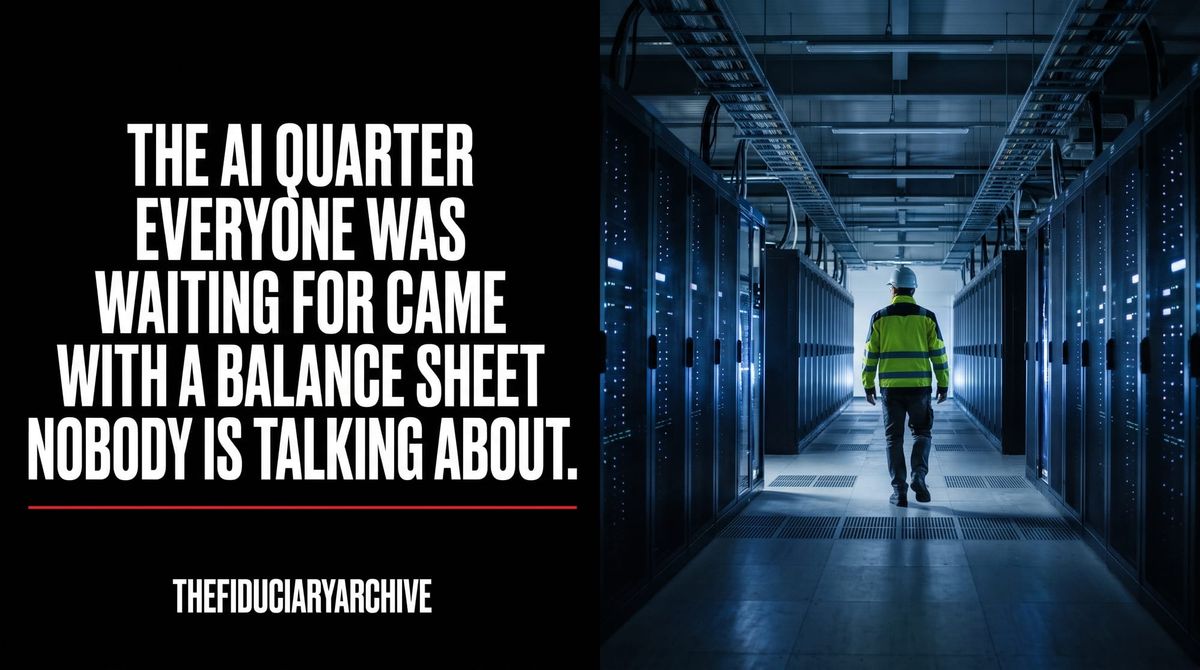
The AI quarter everyone was waiting for came with a balance sheet nobody is talking about.
The Fiduciary Archive · November 11, 2026 · Market Dispatch
CoreWeave Just Reported 168% Revenue Growth and a $132.5 Billion Backlog. It Is Also Carrying $46.9 Billion in Debt With Interest Costs Four Times Its Operating Profit.
The blowout quarter sent shares up 16% pre-market and lifted Nasdaq futures 2%. The balance sheet underneath it tells a different story. And the Fed is raising rates again in December.
By Julian Alden · The Fiduciary Archive · November 11, 2026
CoreWeave reported quarterly revenue of $3.66 billion, up 168% from the same period a year ago. Its contract backlog — the pipeline of future committed revenue — reached $132.5 billion. The shares rose approximately 16% in pre-market trading. Nasdaq-100 futures climbed roughly 2% on the news. By every surface measure, this was the kind of earnings report that AI infrastructure investors had been waiting for: proof that the demand thesis is not theoretical, that the revenue is real, and that the backlog suggests the demand is durable.
The Archive’s practice is to read the footnotes before the headline numbers. The footnotes on CoreWeave’s quarter reveal that the company is carrying approximately $46.9 billion in debt. Its interest costs are running at four times its operating profit. That ratio — interest expense at 4x operating income — is the kind of leverage structure that is manageable when rates are falling and catastrophic when rates are rising. The Federal Reserve is widely expected to raise rates again at its December meeting, with futures markets pricing the probability at approximately 90%. Goldman Sachs is projecting a second hike in March. CoreWeave’s quarter was extraordinary. The environment into which it reported that quarter is not friendly to companies that borrowed $46.9 billion at the peak of the rate cycle.
This is the tension that the Archive wants to hold precisely. The revenue growth is real. The backlog is real. The demand for AI infrastructure is real. The debt is also real. The interest costs are also real. The rate environment in which those interest costs will compound over the next twelve to eighteen months is also real. Investors who buy CoreWeave on the 168% headline and ignore the leverage structure are making a bet that the revenue trajectory outpaces the interest expense trajectory. That is a reasonable bet in a falling rate environment. It is a more complicated bet when the Fed is at 90% probability of a December hike and Goldman is penciling in March.
$3.66 Billion in Revenue. $132.5 Billion in Backlog. What CoreWeave’s Blowout Quarter Actually Means for the AI Infrastructure Trade.
The 168% revenue growth number requires context to be properly interpreted. CoreWeave is a hyperscale GPU cloud provider — it rents computing capacity, primarily to AI developers and enterprises building large language model infrastructure, at a scale that only a handful of companies in the world can match. The demand for that capacity has been growing faster than any single company’s ability to build the data centers to supply it. CoreWeave’s quarter is evidence that the demand side of that equation is not slowing. The $132.5 billion backlog — representing contracted future revenue — suggests that customers are committing to CoreWeave capacity years in advance, which is the behavior of organizations that believe GPU compute will be the scarce resource of the next decade.
The pre-market reaction — shares up 16%, Nasdaq futures up 2% — reflects the market’s relief that the AI demand story, which had been questioned in last week’s selloff, remains intact. The concern that drove technology stocks lower last week was that AI data center construction spending might slow as the new Congress takes shape and regulatory uncertainty around power permitting increases. CoreWeave’s backlog number is the clearest possible rebuttal to that concern: $132.5 billion in committed contracts is not the behavior of an industry that is slowing down. It is the behavior of an industry that is accelerating and locking in capacity before it becomes more expensive to do so.
The Nasdaq-100’s 2% futures gain on the CoreWeave report is a category response, not just a single-stock response. It reflects the market’s reassessment of the entire AI infrastructure ecosystem — chip manufacturers, power providers, cooling systems, fiber networks — every component of the data center supply chain that benefits from CoreWeave-scale demand. The Archive’s interpretation is that this is the correct initial response to the data, with the caveat that the broader ecosystem repricing does not automatically resolve the balance sheet risk specific to CoreWeave itself.

|
A $1,000 stake in Starbucks at its 1992 IPO is worth over $400,000 today.
That is a 40,000% return.
Enough to fund a retirement. Buy a second house. Cover a decade of not caring what the market did that morning.
Wall Street almost missed it.
Starbucks priced at $17 a share in June 1992. Split-adjusted, that is about $0.27. The IPO was oversubscribed, but nothing about the pitch screamed 40,000%. Starbucks was a Seattle chain with 165 stores. The biggest coffee brand in America was still Folgers.
The investors who bought at $0.27 did not need to be geniuses.
They needed to be early.
A new coffee empire is being built in the same window right now.
Different country. Different model. Same window.
Green Coffee Company owns 45 coffee farms in Colombia. 10 million trees. 10,000+ acres. Vertically integrated from tree to shelf. Own the farm, own the mill, own the distribution.
They hold the exclusive US and Canadian grocery rights to Juan Valdez, Colombia’s most iconic coffee brand and a 75-year heritage name. Ten-year commercial agreement, locked in.
The products are on the shelf at Target, Walgreens, Harris Teeter, and 3,000+ North American stores across 21 states.
Revenue grew from $1M in 2021 to $26M in 2025.
The company is still private. Reserved NASDAQ ticker. Reg A+ qualified. Open to all investors, no accreditation required.
Individual investors can buy in at $1.15, per interest. Minimum $1,001. Up to 20% bonus shares.
P.S. Starbucks was a 1992 story. This one is still pre-IPO.
Juan Valdez is a licensed brand. The Juan Valdez parties are not sponsors of this offering.
This is a paid advertisement for Green Coffee Company’s Regulation A offering. Please read the offering circular at https://invest.greencoffeecompany.com/.
Timelines are subject to change. Listing on the NASDAQ is contingent upon necessary approvals, and reserving a ticker symbol does not guarantee a company’s public listing.
Sponsored
$46.9 Billion in Debt. Interest Costs Four Times Operating Profit. The Number That CoreWeave’s Headline Quarter Cannot Make Disappear.
The $46.9 billion debt figure is not a rounding error or a temporary construction-phase liability. It is the structural cost of building data center capacity at the speed CoreWeave has been building it. GPU infrastructure — the NVIDIA H100 and H200 clusters that constitute CoreWeave’s competitive advantage — is expensive. The buildings that house it are expensive. The power infrastructure that runs it is expensive. CoreWeave financed that buildout with debt, and the debt is now larger than the market capitalization of most S&P 500 companies. At $46.9 billion, it is a number that demands attention independent of the revenue trajectory.
The interest coverage ratio — operating profit relative to interest expense — is the metric the Archive watches most closely in a rising rate environment. When interest costs are four times operating profit, a company is not servicing its debt from operations; it is servicing its debt from new capital raises, asset sales, or the expectation that revenue growth will eventually close the gap. For CoreWeave, the revenue growth is extraordinary enough that the gap-closing thesis is plausible. The question is whether revenue grows fast enough to close the gap before the December and March Fed hikes compound the interest cost further.
The rate sensitivity of CoreWeave’s balance sheet is the specific risk that the 16% pre-market pop does not price. A company with $46.9 billion in floating-rate debt — or debt that refinances in the near term — sees its interest costs increase with every Fed hike. If December and March both produce 25 basis point increases, and if CoreWeave’s debt is rate-sensitive, the additional annual interest expense could reach hundreds of millions of dollars. That is not a scenario that changes the fundamental demand story. It is a scenario that changes the timeline on which the fundamental demand story becomes profitable at the entity level.
Your Bank Branch Next to Close???
Why are bank branches quickly and quietly closing across the country??
Click here to see why — and see how to protect your accounts while there is still time.
• PNC Bank: 22 Branches Closing.
• JP Morgan Chase: 66 Branches Closing.
• Citizens Bank: 18 Branches Closing.
• Bank of America: 45 Branches Closing.
In just one week recently, 64 bank branch closures were announced.
What’s going on?
And is your bank branch next?
Click here now to see the details.
This is an advertisement.
If you no longer wish to receive promotional messages from this advertiser, please unsubscribe below. Or write to: 5005 Lyndon B. Johnson Fwy. Suite 350 Dallas, TX 75244
Sponsored
The 168% Revenue Print, the $46.9 Billion Debt, and the Fed That Is Raising Rates Into Both
The Bait
The conventional read on CoreWeave’s quarter is that it validates the entire AI infrastructure investment thesis. Revenue up 168%. Backlog at $132.5 billion. The story is that AI demand is real, that companies are committing to it years in advance, and that the market’s recent skepticism about data center spending was misplaced. This reading is not wrong — the demand thesis is validated by this quarter. The problem is that it frames the CoreWeave question entirely as a demand question when the most important risk is a supply question: can CoreWeave supply the equity market with earnings growth fast enough to service $46.9 billion in debt in a rising rate environment?
The Friction
The interest coverage ratio is the friction that the 16% pre-market pop glosses over. At four times operating profit, CoreWeave’s interest expense is not a footnote — it is the dominant financial reality of the company’s near-term existence. The revenue growth is extraordinary. The debt service requirement is also extraordinary. When the Fed raises rates in December — at 90% market probability — and Goldman expects another hike in March, the interest cost on $46.9 billion in debt does not stay flat. It increases. The question is whether the revenue trajectory’s slope is steeper than the interest expense trajectory’s slope. Last quarter’s numbers suggest it might be. Last quarter’s numbers do not guarantee it will be.
The Extraction
The position that follows is specific. The Archive does not dispute the CoreWeave demand thesis. The $132.5 billion backlog is a real number representing real committed contracts. What the Archive disputes is the market’s tendency to price the demand story without simultaneously pricing the leverage story. For investors who want exposure to the AI infrastructure trade, CoreWeave’s quarter is evidence that the trade is valid. The balance sheet is evidence that CoreWeave itself may not be the optimal vehicle for capturing it in a December-and-March rate hike environment. The indirect plays — the chip manufacturers, the power utilities, the cooling technology companies — carry the same demand exposure without the $46.9 billion in debt. That distinction matters when the Fed is at 90%.
“168% revenue growth. $132.5 billion backlog. $46.9 billion in debt. Interest costs four times operating profit. All four numbers are real. The market is currently pricing the first two.”
Three Positions for the AI Infrastructure Trade When the Best-Performing Company in the Sector Is Also the Most Leveraged
Position One
The Demand Validation Trade — Capturing AI Infrastructure Without the Leverage
CoreWeave’s quarter validates the demand thesis for the entire AI infrastructure ecosystem. The backlog number — $132.5 billion — confirms that hyperscale customers are committing to multi-year GPU compute contracts at a scale that requires years of infrastructure buildout. The Archive’s framework for capturing this validation without the balance sheet risk: the semiconductor manufacturers and power infrastructure companies that supply CoreWeave and its competitors carry the same demand exposure with structurally lower leverage. When CoreWeave signs a $132.5 billion backlog, the chip orders and power contracts that fulfill it flow through to those suppliers. The demand is the same. The debt is not.
Position Two
The Rate Sensitivity Watch — When 90% Probability Meets $46.9 Billion in Debt
The 90% probability of a December Fed hike is not a risk factor that disappears because CoreWeave had a good quarter. It is a rate environment that determines the cost of servicing $46.9 billion in debt for the next twelve to eighteen months. The Archive’s watch is on the composition of CoreWeave’s debt — specifically, what fraction is floating-rate versus fixed-rate, and what the refinancing schedule looks like into 2027. If a significant portion of the $46.9 billion is fixed at pre-hike rates, the balance sheet risk is lower than the headline number suggests. If it is floating or near-term refinancing, the December and March hikes compound directly into the interest expense line. The next earnings call’s debt disclosure is more important than the revenue number for investors thinking beyond the next quarter.
Position Three
The Goldman March Forecast — What a Second Hike in Three Months Does to High-Leverage Growth
Goldman Sachs projecting a March rate hike in addition to December’s expected move is not a consensus call — it is a tail scenario that the market has not fully priced. If Goldman is correct, the rate environment for the first quarter of 2027 is materially tighter than current expectations. For high-leverage growth companies with $46.9 billion in debt, two back-to-back hikes in a three-month window create compounding pressure on the interest coverage ratio precisely when the revenue trajectory needs to accelerate fastest to close the coverage gap. The Archive’s framework for the March scenario: treat it as a low-probability, high-impact event that justifies maintaining duration-short positioning in fixed income and valuation discipline on high-multiple, high-leverage growth equity exposure.
2026 could be the biggest IPO year ever: SpaceX just went public, and Anthropic and OpenAI could be next.
Income expert Tim Plaehn found a much simpler way to play the wave: a little-known fund paying a 20% annualized distribution rate, up to $1,104 a month.
Click here to see Tim’s IPO Income play.
Sponsored
CoreWeave’s quarter is the strongest evidence yet that the AI infrastructure buildout is not slowing. The 168% revenue growth and the $132.5 billion backlog are not numbers that a company invents — they are numbers that reflect actual contracts with actual customers who are actually spending on GPU compute at a scale that the broader market underestimated. That is a real signal, and the Archive takes it seriously.
What the Archive takes equally seriously is that the company reporting those numbers is carrying $46.9 billion in debt into an environment where the Federal Reserve is raising rates at 90% probability in December and Goldman Sachs is forecasting another hike in March. The demand story and the balance sheet story are both true. The market’s job in the coming weeks is to decide which one matters more for the equity price at the current multiple. The Archive’s assessment: the demand story dominates in the near term. The balance sheet story dominates over the rate cycle. Both deserve a seat at the table when sizing a position.
THE MATH REMAINS ABSOLUTE.