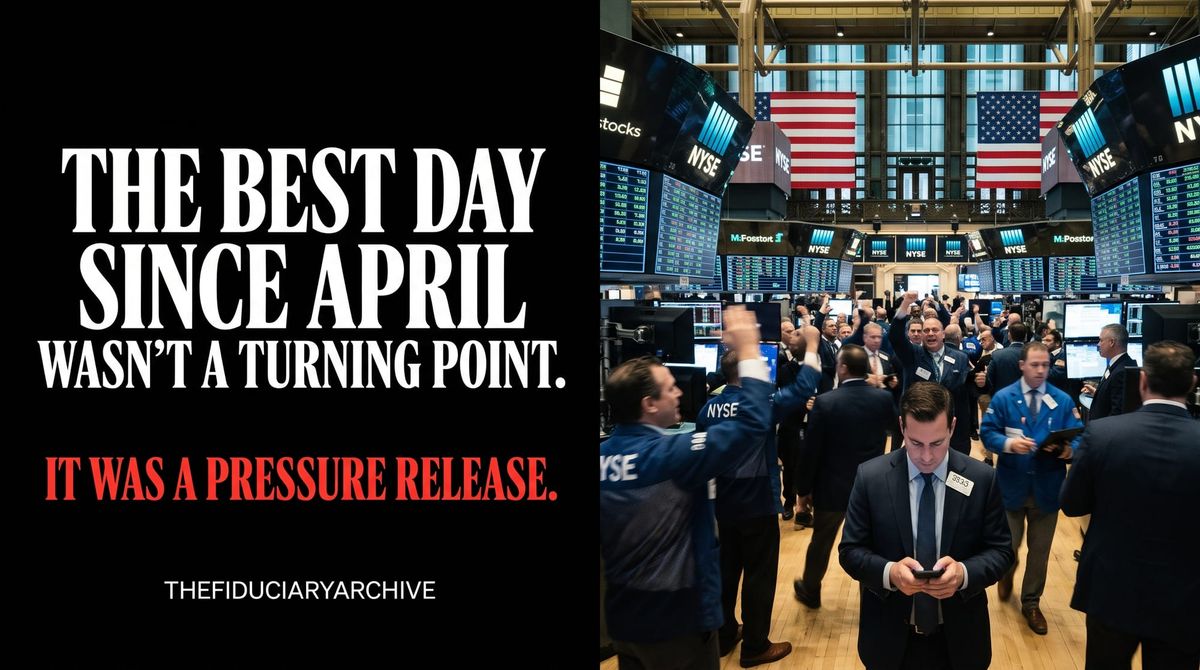
The best day since April wasn’t a turning point. It was a pressure release.
The Fiduciary Archive · November 10, 2026 · Market Dispatch
Wall Street’s Best Day Since April Lasted Until Tuesday Morning, When Inflation Reminded Everyone Why the Rally Was Fragile.
The S&P 500 gained 2.35%. Semiconductors surged 6.9%. The VIX posted its largest single-day drop of the year. Then a hotter-than-expected inflation print arrived, and futures fell.
By Julian Alden · The Fiduciary Archive · November 10, 2026
Monday was the kind of session that feels like a verdict. The S&P 500 gained 2.35%. The Nasdaq surged 2.74%. The Dow added 2.15%. Oil prices dropped, beaten-down technology stocks recovered, and the VIX — the market’s primary measure of fear — posted its single largest one-day decline of 2026. By the close of trading, every index was green, every screen was green, and the dominant narrative in financial media was that the correction had ended and the market was back to where it wanted to be.
The Archive’s job is not to celebrate sessions like Monday. It is to explain what they mean and what comes after them. What Monday meant is that the market had been technically oversold after the previous week’s selloff and was due for a snapback. What came after it was a hotter-than-expected inflation report on Tuesday morning that sent futures lower and reminded investors, with the precision of an actuary, why a one-day recovery in an environment of elevated inflation and Federal Reserve tightening is not the same thing as an all-clear signal.
The sequence — extraordinary gains on Monday, inflation data on Tuesday — is the story of this market in miniature. The trend wants to run. The data keeps pulling it back. Understanding which force is stronger at any given moment is the work of serious investors. The Archive’s assessment, stated plainly: Monday was real. Tuesday was realer.
Semiconductors Up 6.9%. The VIX’s Biggest Drop of the Year. What Actually Drove Monday’s Session.
The proximate cause of Monday’s rally was oil. Crude prices fell sharply, reducing the inflation expectations embedded in longer-duration assets and providing relief to transportation-dependent sectors. Lower oil is a tax cut for consumers and corporations simultaneously — it reduces input costs, lowers operating expenses, and lifts margins without any legislative action required. When oil drops, the market’s worst-case scenarios around cost-push inflation become less urgent, and risk appetite returns. That is exactly what happened Monday.
Semiconductors led the session with a gain of 6.9%. The move was outsized relative to the broader market because semiconductors had been disproportionately punished in the prior week’s selloff — the AI data center slowdown fear had hit chip stocks harder than any other sector. When that fear receded, even partially, the recovery was correspondingly large. The 6.9% gain recovered approximately two-thirds of the previous week’s losses in a single session. That is a significant move, and it reflects the degree to which the sector had been technically oversold rather than fundamentally impaired.
The VIX’s largest one-day drop of 2026 tells the same story. The fear gauge peaked during last week’s technology selloff as investors scrambled for downside protection. When the selloff reversed, the demand for protection collapsed, and the VIX fell precipitously. A falling VIX reinforces the rally — it signals that institutional hedges are being unwound, which releases capital back into equities. Monday’s session had the mechanical structure of a genuine relief rally rather than a dead-cat bounce.

|
My name is Jeff Brown, founder and CEO of Brownstone Research.
Something could happen on November 11 that catches most investors completely off guard.
A tiny stock — trading at under $1 — could announce a supply deal with Elon Musk.
If that happens, the move could be fast.
Similar partnership announcements have sent Musk suppliers soaring…
By as much as 395% in a single day.
And the insider I recently interviewed believes that if you hold a little longer…

|
You could potentially see 39x your money in under two years.
This isn’t a guess.
On page 37 of the SpaceX IPO filing, Musk names the exact sector this company operates in.
And with $85.7 billion from the IPO and another $25 billion from bonds…
Musk is about to go on a huge spending spree.
This company holds the keys to the future of Musk’s AI masterplan.
It’s even helping roll a new Cybercab off the line every 10 seconds.
Including turning $13,140 of his own money into around $1.85 million in under a year.
We put everything in an urgent strategy session…
Including a free ticker you can act on right away.
But you need to see it before November 11.
After that, you could miss out entirely.
Click here to watch the strategy session now.
We have so much to look forward to,
Jeff Brown
Founder & CEO, Brownstone Research
Sponsored
When the Fear Gauge Collapses and Investors Rush Back In, This Is What Risk Appetite Actually Looks Like.
The return of risk appetite on Monday was broad but not undiscriminating. Investors did not simply buy everything — they specifically bought the things that had been sold hardest in the previous week’s correction. That pattern — selling what was down the most when fear peaked, buying it back when fear recedes — is the mechanical signature of institutional repositioning rather than genuine fundamental reassessment. It tells us that the market’s view of semiconductor earnings, AI data center demand, and technology growth rates did not change materially between Friday’s close and Monday’s open. What changed was the near-term risk premium attached to those views.
This distinction matters for how investors should interpret Monday’s session. If the rally reflected a genuine reassessment of fundamentals — new earnings data, revised guidance, a policy change — it would be durable. If it reflected a reduction in near-term risk premium following a technical oversell, it is conditionally durable, meaning it holds as long as no new negative catalysts emerge. Tuesday’s inflation print was a new negative catalyst.
The specific character of risk appetite on Monday deserves attention. It was not speculative — meme stocks, micro-caps, and low-quality names did not lead. The recovery was concentrated in large-cap technology and semiconductors, which are the highest-quality names in the highest-momentum sector. That is different from the kind of risk-on that characterizes speculative excess. Investors returning to Nvidia, ASML, and their peers on a down-oil day is a defensible trade. It is not a signal that the market has abandoned its concern about monetary policy. It is a signal that the market found last week’s selloff to be an overreaction on the specific question of AI infrastructure demand.

|
Flying cars are back in the headlines.
Elon Musk is talking about flying cars again, and the whole category is getting a fresh look.
But headlines don’t fly. Aircraft do.
One company has been doing the hard part for years: designing, building, and flight-testing a personal electric aircraft.
It started in a South Florida garage with a 3D printer. Today its prototype has completed 70+ manned test flights.

|
Its name is Doroni Aerospace. Its Reg A+ share price is $3.72. Minimum investment is $1,000.68.
Doroni is not a rumor. It’s a company running a fully SEC-qualified Reg A+ round:
• 70+ successful manned test flights logged since 2019
• 600+ pre-orders representing over $240 million in potential revenue
• Over $50 million raised from 19,000+ individual investors
• 8 patents filed on propulsion, safety, and aerodynamic systems
• FAA Special Airworthiness Certificate in hand
• $DRNI — Nasdaq ticker already reserved
• Partnership with TLG Aerospace + framework agreement with SES AI on battery development
On July 24 of this year, the FAA opened the first-ever certification pathway for personally-owned electric flying cars. Doroni engineered the H1-X for that pathway from day one.
Bonus shares still apply:
• $2,500–$9,999: 5% bonus shares
• $10,000–$24,999: 10% bonus shares
• $25,000+: 20% bonus shares
On October 20, CEO Doron Merdinger appeared on Fox Business’s “Varney & Co.” and restated the 2028 target for first customer deliveries.
This is a paid advertisement for Doroni Regulation A offering. Please read the offering circular at https://invest.doroni.io/
Sponsored
The Best Day Since April, the Inflation Print That Followed, and Why One Session Cannot Override a Trend
The Bait
The conventional read on Monday’s session is that it was an unambiguous positive. The best day since April. Every index up. Fear down. Oil down. Semiconductors leading. The narrative writes itself: the correction was a buying opportunity, the market has reset, and the path forward is higher. This reading captures something real — the breadth of Monday’s rally was genuine, and the technical conditions that produced it were legitimate. The problem is that it describes a single session in isolation from the data environment in which that session exists.
The Friction
Tuesday’s inflation print arrived on schedule and provided the friction. The report came in hotter than expected. Futures fell. The session that followed on Tuesday was not a catastrophe — it was not the kind of correlated selloff that characterizes genuine panic — but it was a meaningful reminder that the conditions that produced last week’s correction have not been resolved. Inflation is still above the Fed’s target. The December rate hike is still priced at 80% probability. A strong jobs report and a hot CPI in the same week is not an environment in which the Fed feels pressure to pause. Monday’s relief rally happened inside that environment, not instead of it.
The Extraction
The position that follows is specific. Monday was a technically valid relief rally that reduced near-term risk premium in oversold names. It was not a fundamental turn. Tuesday’s inflation print confirmed that the macroeconomic conditions constraining equity multiples have not changed. The Archive’s framework for the remainder of November: treat rallies driven by oil price declines and VIX compression as tradeable but not investable. The tradeable move is the momentum recovery in beaten-down quality. The investable question — the one that determines whether this is a buying opportunity or a brief reprieve — is whether December’s Fed statement closes the door on further hikes. Until it does, the ceiling on this market is lower than the bulls believe.
“The best day since April lasted eighteen hours. Then the inflation data arrived.”
Three Positions for a Market That Rallies 2.35% on Monday and Gets a Hot CPI on Tuesday
Position One
The Semiconductor Recovery Trade — Quality Names, Not Momentum Chasing
The 6.9% gain in semiconductors on Monday was a compression release after an oversold week. The underlying thesis — that AI infrastructure demand is structurally elevated and that the leading chip companies are the primary beneficiaries — did not change between Thursday’s close and Monday’s open. The Archive’s framework here is to distinguish between the thesis and the near-term risk premium. The thesis is intact. The risk premium fluctuates with VIX levels and oil prices. Quality semiconductor names purchased during VIX spikes and sold into VIX compression is not a novel strategy — it is the mechanical application of mean reversion to a structurally sound sector. The November-December Fed cycle is the duration of that trade, not an indefinite holding period.
Position Two
The Hot CPI Hedge — What Tuesday’s Print Changes and What It Doesn’t
A hotter-than-expected CPI print in a week that also contained a 3x jobs beat is the worst possible combination for investors positioned for a Fed pivot. It confirms that the economy is running above the Fed’s preferred pace on both the employment and inflation dimensions simultaneously. The Archive’s hedge for this environment is not a speculative short — it is a duration reduction. Shortening the duration of fixed-income holdings and reducing exposure to long-duration growth equities whose valuations depend on a lower discount rate is the defensive repositioning that the November data flow has validated. This is not a prediction of collapse. It is a recognition that the risk-reward of long duration has deteriorated further since Tuesday.
Position Three
The Oil Price Signal — When Lower Crude Drives a Rally and When It Doesn’t Last
Monday’s rally was driven in part by falling oil. Oil-driven rallies are real but not always durable, because oil prices reflect global supply and demand dynamics that are not reliably directional over short time horizons. The Archive’s watch for the remainder of November is whether the oil price decline persists or reverses. A sustained decline in crude — driven by demand weakness or supply expansion — is structurally disinflationary and would provide real support for the equity multiple expansion that rate-sensitive stocks need. A reversal back toward previous oil price levels would remove one of the two tailwinds that powered Monday’s session and leave the market more exposed to the CPI data that Tuesday delivered. The oil price in the last two weeks of November is a more important market variable than it typically receives in mainstream coverage.
Trump’s economic plan is already reshaping the conversation around retirement.
Your FREE 2026 Wealth Protection Guide is still available — but this may be the last reminder you get.
Inside: tax- and penalty-free transfer options, physical gold, and ways to reduce exposure to Wall Street volatility.
Just enter your details to get your free guide.

|
Sponsored
The week that began with Wall Street’s best session since April ended, within eighteen hours, with a CPI print that reminded investors of exactly why the correction had happened in the first place. This is not irony. It is the structure of a market that is simultaneously responding to short-term technical conditions and longer-term macroeconomic constraints. The technical condition — oversold quality technology stocks after a fear-driven selloff — resolved on Monday. The macroeconomic constraint — inflation above target, Fed still tightening, real rates rising — reasserted itself on Tuesday.
The Archive’s summary position entering the second half of November is that the December FOMC meeting is the event that matters most. Everything between now and then — every session like Monday, every print like Tuesday — is data that will inform that meeting but not resolve it. Investors who are positioned for the December outcome rather than the daily news flow will be better served than those who trade the headlines. Monday was a good headline. Tuesday was a good reminder of why headlines are not enough.
THE MATH REMAINS ABSOLUTE.