
Trump Said "We Don't Need China's Help on Iran" Yesterday — Then Drove to the Airport to Meet Xi on the Tarmac.
Geopolitical Capital Audit
Xi Lands at Andrews Today. Trump Meets Him on the Tarmac. The Summit That Has to Answer the Satellite Imagery Report — and Three Other Questions That Actually Move Markets
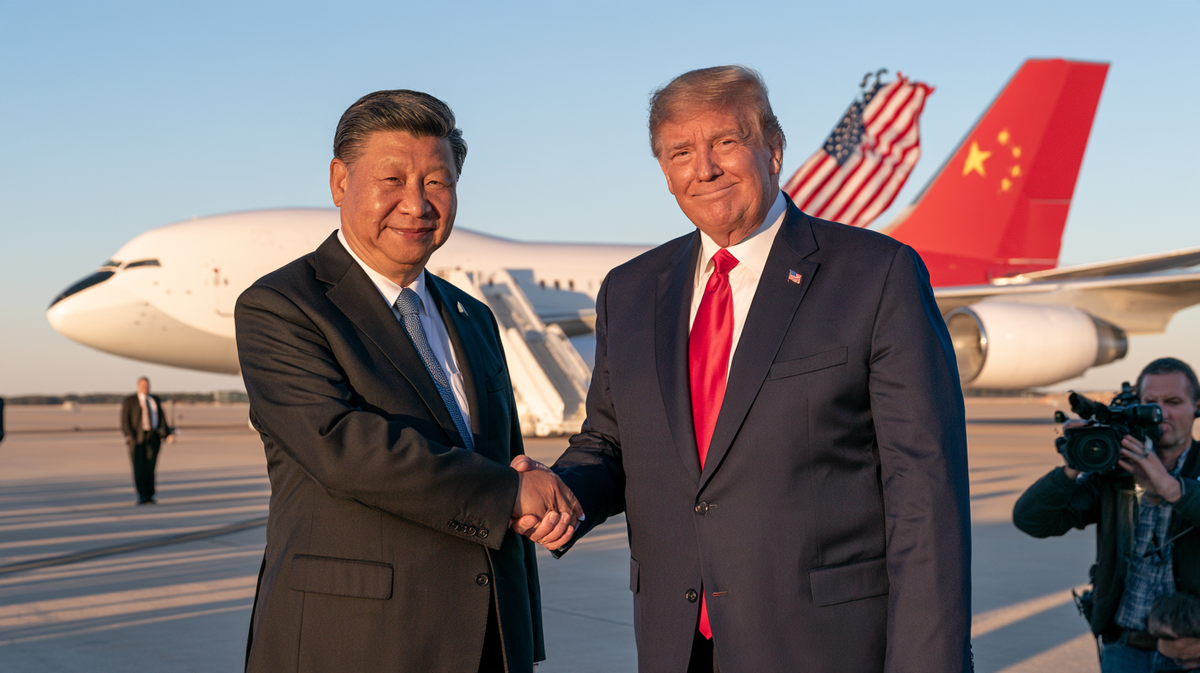
Xi Jinping arrives at Joint Base Andrews this afternoon for his first U.S. state visit in 11 years. Trump will greet him personally on the tarmac — a rare protocol gesture. Bilateral talks and a state dinner are Thursday. The official agenda: tariffs, rare earths, AI, Taiwan. The real agenda: Iran, Chinese satellite imagery that killed three Americans, Hormuz, and whether Beijing is willing to use its leverage over Tehran to end a war that has pushed Brent above $100 and the Fed funds rate to 4.00%. The Archive reads both agendas.
Xi's Washington visit is his first since 2015 — eleven years. The Busan summit in October 2025 was their first direct meeting; the Beijing summit in May 2026 was their second; today is their third in under a year. The acceleration of the meeting cadence tracks the acceleration of the Iran war's economic consequences: each summit has arrived at a moment when oil prices, rate decisions, or diplomatic crises have made the bilateral relationship too consequential to manage at the deputy level. The three-day visit includes a South Lawn arrival ceremony, a military review in the Rose Garden, and a state dinner. The bilateral talks are Thursday. Trump's tarmac welcome — departing the White House to personally receive Xi at Andrews — is the specific protocol signal that Washington wants China to see the visit as consequential rather than routine.
The backdrop the summit walks into: Brent at $97 after Monday's anonymous Iranian official told Reuters and Kyodo that Hormuz could reopen in seven days if the U.S. eases military pressure — a signal the market priced before CNBC noted it could not verify it. Trump on the Iran talks Monday: "We're either going to make a deal or they're going to be decimated, one way or the other." Trump on the war and elections, confirmed again this week: "The war will end very shortly after the election." Trump on China's role: asked Tuesday whether Beijing should intervene to help end the war, he gave conflicting answers before settling on "We don't need China's help on Iran" — a statement that arrived 24 hours before Xi's plane.
The Archive's read: Trump saying "we don't need China's help" the day before Xi lands is not policy — it is leverage positioning. China is Iran's primary economic lifeline. The blockade of Iranian ports has left Tehran reliant on diminishing floating stockpiles. China's continued purchase of Iranian oil, its satellite imagery firms' documented role in targeting U.S. forces, and its diplomatic relationships with Tehran give Beijing more operational leverage over the war's trajectory than any other third party. "We don't need China's help" is what you say when you want China's help but do not want to pay the diplomatic price of asking for it publicly. The Archive reads the summit's actual deliverable as what China offers on Iran — and whether it is enough to produce the pre-election oil price relief that $97 Brent and a 4.00% Fed funds rate make politically urgent.
Fiduciary Recommendation — Ad
|
I.The Four Questions the Summit Has to Answer — in Order of Capital Consequence
First: Will China use its Iran leverage — and what does it want in return?
CNN reported this week that US-Iran talks are "unlikely to make significant progress" before the Trump-Xi summit, citing a regional source who said movement in the talks would "depend on the results" of the summit. China is Iran's primary economic lifeline and its primary diplomatic interlocutor. China's envoy has been calling for a "comprehensive ceasefire" and meeting with Iran's foreign minister ahead of the summit. The question is not whether China has leverage over Tehran — it does, documented and substantial. The question is what China wants in exchange for using it: tariff relief, rare earth export normalization, technology restriction rollbacks, Taiwan security guarantees, or some combination. The summit's Iran dimension is a transaction negotiation, not a humanitarian appeal. The Archive watches the communiqué for any language linking Hormuz, ceasefire, or Iranian diplomacy to U.S. trade or technology policy concessions.
Second: The satellite imagery report has to be addressed — and the framing matters.
The WSJ reported September 11 that Chinese entities provided high-resolution satellite imagery of Muwaffaq Salti Air Base before the July 17 attack that killed three Americans. U.S. officials called it the "clearest indication so far that Chinese support for Iran has had lethal consequences for American forces." Three Americans died. The White House said "no outside assistance improved Iran's targeting" — contradicting its own intelligence officials in the same article. That contradiction is now embedded in the pre-summit public record. Xi cannot walk into the state dinner without the imagery question being on the table. Trump cannot sit across from Xi without having answered why the White House statement contradicts the intelligence assessment. The framing of that answer — whether Washington characterizes the imagery firms as rogue actors or as state-linked entities — determines whether the post-summit OFAC sanctions list expands. The Archive watches that framing as the single most consequential signal of the visit for U.S.-China technology sector exposure.
Third: Rare earths are the trade variable with the most direct supply chain consequence.
Several commitments from the May Beijing summit remain unfulfilled — including China easing access to rare earth minerals, committing to additional agricultural purchases, and creating a bilateral Board of Trade. Craig Singleton of the Foundation for Defense of Democracies told reporters this week: "China is still using rare earths and other supply chain dependencies as leverage against us, and Washington is still tightening restrictions across technology, infrastructure and economic security." Rare earth export normalization is the specific deliverable that would affect defense manufacturing, battery production, EV supply chains, and the semiconductor ecosystem simultaneously. A concrete agreement on rare earth access — even a framework for phased normalization — is the trade deliverable that moves the most sector exposure in a single communiqué line. The Archive watches rare earth language before tariff language: the tariff numbers are arithmetic; the rare earth terms are structural.
Fourth: The "war ends after the election" admission is the context China is actually negotiating in.
Trump confirmed publicly, twice, that the war ends "immediately after the election" — because Iran "can't hold out any longer" and is "hoping to get weak Democrats in." Xi's negotiating team has read that statement. It tells Beijing that the war has a published American end date: November 3. It tells Beijing that the pre-election window — 41 days — is when Washington is most constrained and most in need of diplomatic cover. It tells Beijing that its leverage is time-limited: after November 3, Trump has stated his intention to end the war on American terms, which reduces China's diplomatic mediation value. China has maximum leverage in this 41-day window. The Archive reads the summit as Beijing's attempt to extract the maximum possible trade and technology concession before that window closes. "We don't need China's help" is Trump's public posture. The tarmac welcome is his operational signal. Those two things are not the same.
The Summit Agenda
Archive Priority Read
Iran / Hormuz
Will China use its Tehran leverage — and at what price?
Satellite imagery / WSJ report
Entity framing determines post-summit OFAC list
Rare earths
Most structurally important trade deliverable
Tariffs
Arithmetic, not structural — watch for framework language
AI / technology restrictions
China's chip access vs. U.S. export controls — no resolution expected
Taiwan
Xi has Xi's assurance on Trump's term — status quo expected
*The Useful Message: The official agenda is tariffs, rare earths, AI, Taiwan. The real agenda is Iran — specifically whether China will use its Tehran leverage to move Brent below $95 before the October 15 CPI and the November 3 election. Every other agenda item is negotiating currency for that transaction.
II.Forensic Dissection: The Tarmac Welcome and What It Costs
The Bait
Trump meeting Xi on the tarmac at Andrews is genuine diplomatic signaling — it communicates that the U.S. values the relationship enough to depart from protocol precedent. The summit's full ceremonial program — South Lawn arrival ceremony, military review, state dinner, bilateral talks — is the most complete state visit the Trump administration has offered any foreign leader. This communicates seriousness of purpose. The three-summit cadence in under a year (Busan, Beijing, Washington) is the fastest pace of U.S.-China leadership engagement since the Nixon era. The bilateral relationship, whatever its tensions, is being managed at the leader level rather than delegated to deputies. That structural engagement is itself a form of stability that prevents the miscalculations that escalate rivalry into conflict.
The Friction
The May Beijing summit produced commitments that remain unfulfilled four months later — rare earth access, agricultural purchases, the bilateral Board of Trade. The tarmac welcome and the state dinner are the visible signal of the relationship's importance. They are not evidence of its productivity. China is sitting across from a U.S. president who has publicly confirmed the war ends after the November 3 election — which means China's leverage window is 41 days. Beijing has every incentive to extract maximum concessions in this window rather than deliver the Iran diplomatic assistance that would reduce its leverage. A warm summit that produces a joint communiqué full of frameworks, working groups, and principles — but no concrete rare earth agreement, no satellite imagery accountability language, and no Hormuz commitment — is the specific outcome that looks like diplomacy and delivers nothing for Brent, for October 15 CPI, or for the pre-election economic environment. The tarmac welcome buys goodwill. The communiqué delivers or does not.
The Extraction
The Archive prices three summit outcomes. Best case for oil and October 15 CPI: China delivers a concrete Iran diplomatic commitment — a joint statement on Hormuz, a private assurance to Tehran delivered through Beijing that the blockade terms are acceptable, or a visible reduction in Chinese satellite imagery firm activity — and Brent moves below $95 on the communiqué. October 15 CPI moderates. December Fed meeting becomes genuinely ambiguous. This scenario is the most valuable and the least probable based on China's 41-day leverage calculation. Middle case: warm summit, frameworks and working groups, no concrete Iran deliverable, Brent holds $97–100, October 15 CPI reflects the pre-summit energy environment. Most probable. Worst case for markets: summit produces no concrete deliverables on rare earths, Iran, or satellite imagery, and Trump responds with additional sanctions or tariff threats within 72 hours. Brent re-approaches $105. October 15 CPI worse than anticipated. This is the scenario that follows from China's incentive to use the leverage window rather than close it.
"The Archive reads the Trump-Xi summit through the lens of the October 15 CPI — the inflation print that arrives 19 days before the election and that prices every remaining question about the December Fed meeting, the House majority, and the war's economic legacy. If the summit produces a China diplomatic commitment on Iran that moves Brent below $95, October 15 looks better. If it produces frameworks and a state dinner photo, October 15 looks like the pre-summit energy environment. Trump said 'we don't need China's help' the day before Xi landed. He drove to the airport to meet him on the tarmac. The Archive reads the second sentence."
III.The Sovereign Blueprint: What to Watch in the Communiqué Thursday Evening
Read the Hormuz and Iran Paragraphs First
The summit communiqué will be released Thursday evening after the state dinner. The Archive reads it in one specific order: Iran/Hormuz language first, rare earths second, satellite imagery third, tariffs last. Any joint language on "freedom of navigation" in the Strait of Hormuz, any reference to the conditions for reopening, or any language on Iran's nuclear program that goes beyond prior joint statements is the signal that China delivered something concrete. Absence of Hormuz language — or language so vague as to be consistent with China's existing positions — is the signal that the Iran transaction did not close. That determination, made Thursday evening, prices Friday's Brent open.
Rare Earth Language Is the Structural Trade Signal
The May summit produced a rare earth commitment that was not implemented. If Thursday's communiqué includes a concrete rare earth export normalization agreement — specific minerals, specific timelines, specific volumes — it is the most structurally consequential trade deliverable for the defense manufacturing, battery, and semiconductor supply chains that dominate the Archive's technology sector exposure. A framework agreement or working group language on rare earths is the May outcome recycled — it prices as neutral. A concrete implementation schedule prices as structurally positive for U.S. manufacturing and structurally negative for Chinese rare earth leverage.
Watch the Post-Summit OFAC List — Not the Summit Photo
The state dinner photo will be warm. The tarmac welcome was warm. The Archive does not trade warmth. The signal that matters in the 30 days after the summit is the OFAC sanctions list — specifically whether additional Chinese satellite imagery firms are sanctioned. Additional sanctions signal that the satellite imagery discussion produced no satisfactory Chinese response and Washington is escalating through the "entity, not government" track. No additional sanctions signal that China offered something sufficient to pause the escalation. This is the same framework the Archive identified after the WSJ report on September 11. The summit does not resolve it — it either produces a private Chinese assurance that changes the trajectory, or it does not. The OFAC list tells you which.
Xi lands at Andrews this afternoon. Trump meets him on the tarmac. The state dinner is Thursday. The communiqué follows. The official agenda is tariffs, rare earths, AI, Taiwan. The real agenda is whether China will use its Iran leverage before the November 3 window closes — and what it wants in exchange. Trump said "we don't need China's help on Iran" on Tuesday. He drove to the airport. The Archive reads the action, not the statement. Watch the Hormuz paragraph in Thursday's communiqué. That paragraph prices Friday's Brent open, October 15's CPI, and everything downstream from both.
THE MATH REMAINS ABSOLUTE.