
The Fed Hiked to 4%, Diesel Hit $6.31 All-Time Record, and Trump Called the Board "Hostile" — All on the Same Day.
September 16 Audit
12–0 Hike, Diesel at $6.31, Dow Down 631 — and Trump Called the Fed Board "Hostile" Before the Day Was Over
Wednesday produced three simultaneous events that share one underlying driver: the Iran war's energy premium. The FOMC voted 12–0 to raise rates to 3.75%–4.00% — first hike since 2023. Diesel set an all-time record at $6.31 per gallon. Gasoline hit $4.37 nationally. The Dow dropped 631 points. Trump called Warsh trustworthy and the Fed board "hostile" in the same statement. Brent pulled back from $108 to $103 Thursday after Energy Secretary Chris Wright said the damaged Saudi pipeline would be restored soon. The Archive reads the day as a single story, not three.
The FOMC voted unanimously — 12–0, including the three July dissenters who had pushed for an earlier move — to raise the federal funds rate by 25 basis points to a range of 3.75%–4.00%. The dot plot showed 16 of 18 participants expect at least one more hike this year; four see two more possible; two see September as the last. Warsh did not submit a dot. The 10-year Treasury topped 5% during the session. Mortgage rates hit 7.19%. All three major indices were higher before 2:00 PM ET — and fell after Warsh spoke. The Dow closed down 631 points, the S&P 500 –0.45%, the Nasdaq flat. Goldman Sachs led the Dow lower. The statement said today's action will "support a timelier return to the Committee's 2 percent goal." Warsh at the press conference: "This summer's inflation readings do not tell me that underlying trends have meaningfully improved."
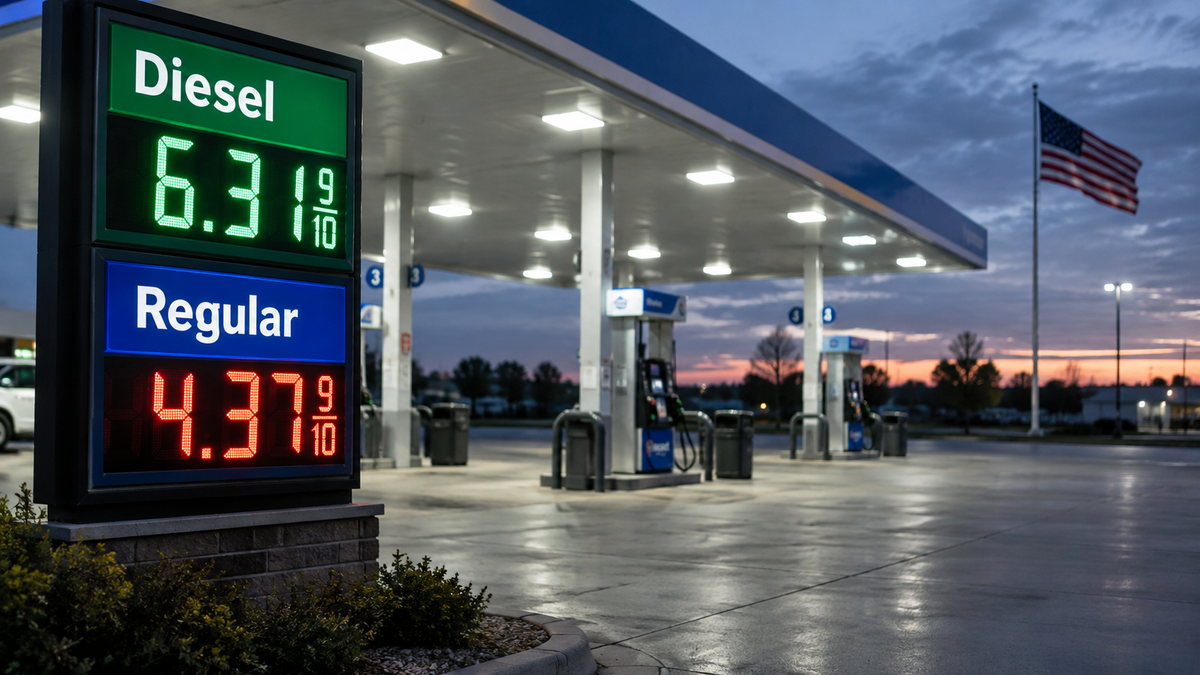
While Warsh was speaking, diesel fuel was setting an all-time national record at $6.31 per gallon — the fuel type that moves every truck, train, and farm implement in the American economy. Regular gasoline averaged $4.37 nationally, up from $3.19 a year ago — a 37% increase in twelve months. Brent crude had hit $108 on Tuesday before Energy Secretary Chris Wright said Wednesday that the damaged Saudi pipeline from the Houthi strikes would be repaired soon, pulling Brent back toward $103 on Thursday. The commodity market's 5% intraday move on a government statement about pipeline repair is the clearest measure of how much of the current price is geopolitical premium rather than structural supply deficit.
Trump responded the same evening. He said the rate should be "1% or lower." He said he "still trusts" Warsh. He called the rest of the Federal Reserve board "hostile." The Archive reads those three sentences as a single communication strategy: preserve the personal relationship with the chairman while establishing political distance from the institution and its decision — positioning for the November 3 electoral environment where $4.37 gasoline and a Fed rate hike are both liabilities that need separate narratives. The "I trust Warsh, but the board is hostile" construction is the specific framing that allows Trump to criticize the institution without creating a constitutional confrontation with its chair.
Sponsored Partner Content — Ad
|

I.The Three Numbers That Share One Driver
$6.31
Diesel — All-Time Record
Every truck, train, farm in America
$4.37
Regular Gas — National Avg
vs. $3.19 a year ago (+37%)
4.00%
Fed Funds Rate — New Ceiling
First hike since July 2023
The diesel record is the number that moves everything else.
Diesel at $6.31 is not a consumer story — it is a supply chain story. Every manufactured good that arrives by truck pays a fuel surcharge that scales with diesel. Every agricultural product carried by a freight train. Every home heating oil delivery in the Northeast. The diesel all-time record arrived on the same day the Fed hiked to contain inflation. The Fed cannot affect the diesel price. The diesel price will affect the inflation the Fed is trying to contain. Washington Times captured the specific downstream consequence that Senate Minority Leader Schumer raised during the day: "Some American stores have started to ration motor oil — that's how desperate the situation has become. And when the price of gas goes up, so does the price of everything else." The Archive reads diesel at $6.31 as the October 15 CPI leading indicator — the number that will appear in next month's goods inflation component before the November 3 election.
What Warsh said about energy is the sentence that priced the Dow's decline.
The indices were positive before 2:00 PM. The S&P 500 cut its gains and went negative during Warsh's press conference — specifically after he said "this summer's inflation readings do not tell me that underlying trends have meaningfully improved." That sentence is not about energy. It is about core inflation — and it is the hawkish read of an August core CPI that came in at 2.4%, slightly below July's 2.5%. A Fed chair who says core CPI declining from 2.5% to 2.4% does not tell him that underlying trends have improved is a Fed chair who is not signaling a pause after one hike. The Dow's 631-point decline is the market pricing the dot plot — 16 of 18 participants expect at least one more hike this year — against Warsh's press conference language. The Archive called this trade in yesterday's briefing: watch what Warsh says about inflation at 2:30 PM. He said it was not improving. The Dow heard it.
The Brent pullback from $108 to $103 on Thursday — after Wright's pipeline comment — is the geopolitical premium at work in the opposite direction. A government official says a Saudi pipeline will be repaired and oil moves 5% in a day. The underlying supply situation has not changed. The Strait of Hormuz transit remains suppressed. Saudi southern facilities remain partially disrupted. But the premium that the market had priced for the worst-case supply scenario partially decompressed on a reassuring statement. The Archive watches whether Brent holds $103 or re-approaches $108 as the signal for whether Wright's pipeline timeline is credible.
II.Forensic Dissection: The "Hostile Board" Framing and What It Actually Signals
The Bait
Trump's reaction is predictable and political. Every president since Nixon has publicly pressured the Federal Reserve — and every one of them has been ignored. The "1% or lower" statement is the electoral positioning of a president whose party faces record gas prices and a rate hike six weeks before a midterm election. "Hostile board" is the framing that gives Trump's voters someone to blame for high borrowing costs that are not his fault. The institutional independence of the Federal Reserve is robust enough to absorb presidential criticism — it has been absorbing it continuously since February. The Dow's 631-point decline reflects the dot plot and Warsh's press conference language, not Trump's statement.
The Friction
The "I trust Warsh but the board is hostile" construction is not just electoral positioning — it is a documented institutional stress signal. A president who has called the board hostile while simultaneously saying he trusts the chair has created a public record that separates Warsh from his colleagues on the Fed's Board of Governors. If market conditions deteriorate further — if October CPI comes in hot, if the Dow extends its decline through September, if Brent re-approaches $108 — the political pressure on the board distinction will increase. Trump cannot remove Warsh without triggering a constitutional confrontation. He can continue to delegitimize the board in ways that affect the Fed's communication effectiveness and market credibility. The "hostile board" framing is the opening of that playbook, not a throwaway line.
The Extraction
Three concurrent positions now define the U.S. monetary environment: a Fed that has hiked to 4.00% with 16 of 18 participants expecting at least one more; a president publicly calling for 1% rates and labeling the board hostile; and diesel at an all-time record that will feed into October CPI before the November 3 election. These three positions are structurally incompatible. The Fed cannot lower rates to 1% while diesel is at $6.31 and the dot plot shows two more hikes as possible. The president cannot close the distance between 4.00% and 1% without either removing Warsh — which he has said he will not do — or waiting for an inflation shock large enough to force a reversal. The diesel record and the "hostile board" framing are the two variables the Archive watches as leading indicators of whether the incompatibility becomes a confrontation before or after November 3.
"Warsh said at the press conference: 'We cannot affect any individual price. But what we can do and will do is ensure that any change in relative prices don't broaden out, don't have second and third order effects on the economy.' The Archive reads that sentence as the Fed's honest statement of its operational limits and its institutional mandate simultaneously. The Iran war produces $6.31 diesel. The Fed cannot fix the diesel price. It can try to prevent the diesel price from becoming a wage-price spiral. That is what 4.00% is for. Whether it works depends on whether the war ends before the second and third order effects fully embed — which the president has told us happens immediately after November 3."
III.The Sovereign Blueprint: Three Positions After the Hike
The Dot Plot Median Is December — Price It Now
The dot plot showed 16 of 18 participants expecting at least one more hike in 2026. The median projection is a December hike to 4.00%–4.25%. No cuts are penciled in for 2027. One cut each is indicated for 2028 and at least one for 2029. The yield curve through the FOMC's projection window is flat-to-inverted for the medium term. The 10-year Treasury topping 5% on Wednesday is the bond market pricing the December hike probability and the no-cut 2027 projection simultaneously. Sub-90-day T-bills remain the correct duration position through the October 15 CPI release — which is the next inflation print that will either confirm or test Warsh's "no meaningful improvement in underlying trends" language.
Diesel at $6.31 Is the October 15 CPI Leading Indicator
The diesel all-time record set Wednesday transmits through the goods economy over approximately four to six weeks — arriving in the October CPI survey period that closes September 30 and releases October 15. The Archive documented this transmission chain in the PPI briefing: record diesel → freight surcharges → consumer goods prices → CPI goods component. A Fed that has just hiked to 4.00% with the dot plot showing one more hike will face an October 15 print that reflects $6.31 diesel embedded in goods costs. If the October print shows core re-accelerating above 2.4%, the December hike becomes near-certain and the 2027 no-cut projection is tested. The Archive watches diesel weekly — not as a driving story, but as a CPI leading indicator.
Watch the Brent $103 Hold — It Prices the October Premium
Brent's pullback from $108 to $103 on Wright's pipeline comment is a geopolitical premium compression event — not a supply fundamentals event. The Strait of Hormuz remains suppressed. Saudi southern facilities remain partially disrupted. Trump has confirmed the war posture persists through November 3. The pipeline repair comment removed the worst-case scenario premium. It did not remove the war premium itself. If Brent holds $103 through the pipeline repair timeline, the October energy CPI component moderates. If Brent re-approaches $108 on any new supply disruption event before October 15, the October CPI is worse than September's. The Archive watches the $103 level as the dividing line between a manageable October CPI print and an unmanageable one.
Wednesday, September 16: 12–0 hike to 4.00%. Diesel at $6.31 all-time record. Gasoline at $4.37. Dow –631. 10-year Treasury above 5%. 16 of 18 Fed participants expecting at least one more hike this year. Trump: "1% or lower. I trust Warsh. The board is hostile." Brent at $103 Thursday after Wright's pipeline comment pulled it back from $108. The war is the driver. The Fed cannot fix the war. The diesel is the leading indicator. October 15 is the settlement date.
THE MATH REMAINS ABSOLUTE.