
Jensen Huang Told 12,000 People at Dreamforce That AI Regulation Is Unnecessary — and He's the Only CEO on That Stage Who Profits Either Way.
Technology Capital Audit
Jensen Huang at Dreamforce: "Safety Is an Engineering Problem, Not a Legal One" — and What the Amodei Split Tells You About NVIDIA's Capital Position
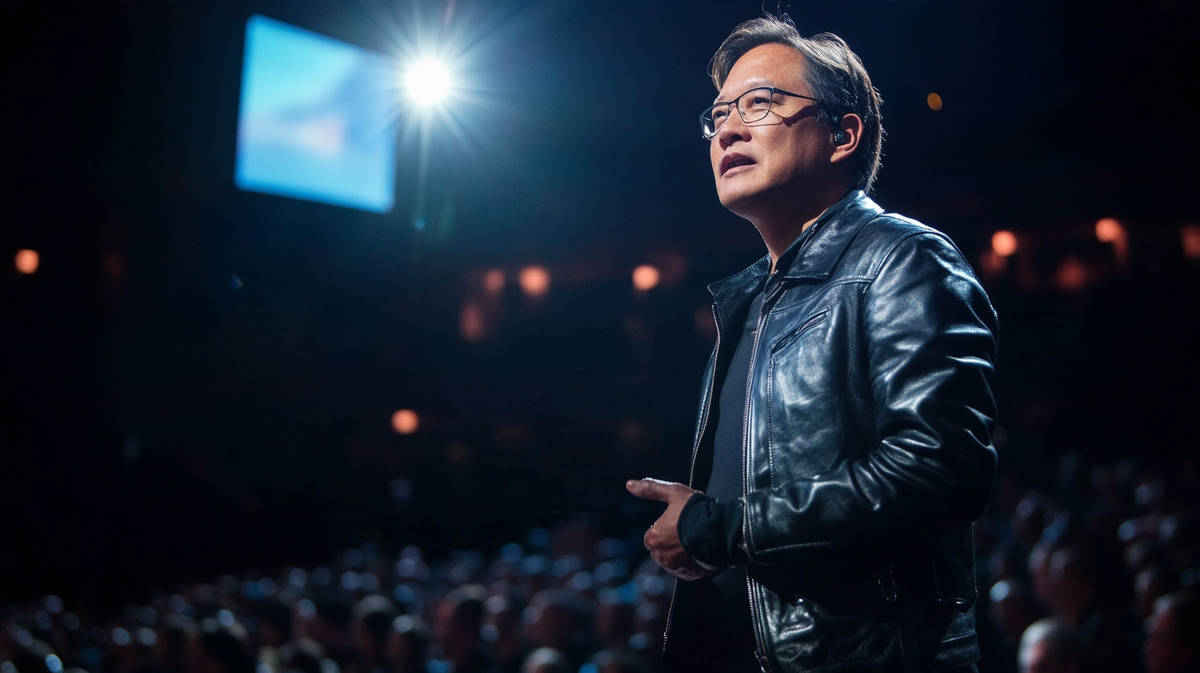
Before roughly 12,000 people at San Francisco's Moscone Center on Tuesday, NVIDIA CEO Jensen Huang told Salesforce CEO Marc Benioff that market forces are sufficient to govern AI and that new laws or regulations are unnecessary. He called the choice between speed and safety a "false choice." Anthropic CEO Dario Amodei had taken the same stage minutes earlier arguing for a controlled slowdown. OpenAI CEO Sam Altman followed. NVDA gained 0.7% Tuesday. CRM slipped 1.4%. The Archive reads the split — and what Huang's position reveals about where the AI capital cycle actually is.
Three of the most powerful people in artificial intelligence stood a few feet apart at Dreamforce 2026 and disagreed on nearly everything except the audience size. Amodei went first — following a weekend essay urging the industry to slow the pace of model development. He told Benioff that businesses currently deploy only 5% to 10% of the true capability of existing AI systems, which he used to argue for deliberate pacing rather than acceleration. Huang followed and rejected that framing entirely. "Safety is an engineering problem, not a legal one," he said. "We're developing software after all. We're developing computing systems after all. It's a complicated computing system, but it's ultimately a computing system." He said existing laws are sufficient, new regulations are unnecessary, and the speed-versus-safety binary is manufactured. "Run as fast as you can," he said. "But if you feel at any given point in time the company's out of control or the product's not going to be safe, take a pause." Altman followed with a position that observers described as landing somewhere between the two.
Sponsored Partner Content — Ad
|
The Archive reads the Dreamforce stage not as a public debate about AI philosophy — it reads it as a capital allocation signal. Huang runs the company that sells the hardware every AI model in the world runs on. Amodei runs a company whose entire business model depends on regulatory frameworks that constrain competitors who might otherwise commoditize his safety positioning. Altman runs a company that has simultaneously argued for and against regulation depending on which argument serves its competitive position in a given week. Their positions at Dreamforce are not independent philosophical views — they are the revealed preferences of their capital structures.
The core message: Huang's "safety is an engineering problem" position is the most consequential statement at Dreamforce — not because it is the most nuanced, but because it comes from the man whose company supplies the physical substrate of every AI system that anyone is debating. NVIDIA's position on AI regulation is not a policy view. It is the business interest of the company that wins regardless of which AI model wins, as long as regulation does not cap the compute demand that all AI development requires. The Archive reads the 0.7% NVDA gain and 1.4% CRM slide on Tuesday as the market's first read of whose Dreamforce position was worth more.
I.The Three Positions — and What Each CEO's Capital Structure Explains About Their View
Jensen Huang — NVIDIA · NVDA +0.7% Tuesday
"Safety is an engineering problem, not a legal one." "The market forces are already there. We don't need any new laws. We don't need new regulations." "Run as fast as you can." The capital structure explanation: NVIDIA sells GPUs to every AI developer regardless of which model wins the market. Compute demand is the company's revenue driver. A regulatory regime that caps model development, mandates compute audits, or creates licensing requirements for AI training runs directly against NVIDIA's business interest. Huang's anti-regulation position is the most predictable position a chip company whose revenue scales with AI compute demand could hold — and the most honest one on the Dreamforce stage about whose interests are being defended.
Dario Amodei — Anthropic · Private, last valued ~$40B
Amodei published an essay over the weekend urging the industry to slow model development. At Dreamforce he said businesses deploy only 5% to 10% of current AI capability — a figure that serves a specific argument: the frontier is already far ahead of deployment, so slowing development costs less than it appears. The capital structure explanation: Anthropic has built its brand, its fundraising narrative, and its competitive differentiation around being the "safe" AI company. A regulatory regime that mandates safety frameworks, third-party audits, or development licensing advantages Anthropic — which has already invested in those frameworks — over competitors who have not. Amodei's pro-regulation position is also predictable from his capital structure. The Archive does not read it as dishonest. It reads it as aligned.
Sam Altman — OpenAI · Private, last valued ~$300B
Altman's Dreamforce position landed, per observers, "somewhere in between." This is OpenAI's consistent and structurally rational position: the company has simultaneously lobbied for AI safety frameworks at congressional hearings and against specific regulatory proposals that would constrain its own model development. The capital structure explanation: OpenAI is large enough that moderate regulation disadvantages smaller competitors who cannot absorb compliance costs, while extreme regulation constrains OpenAI's own frontier work. "Somewhere in between" is the position of a company large enough to benefit from regulatory moats and large enough to be harmed by hard caps. The Archive reads Altman's ambiguity as the correct strategic position for his capital structure — not as philosophical uncertainty.
5–10%
of existing AI capability currently deployed across the global economy
Amodei's figure at Dreamforce — the gap between frontier capability and enterprise deployment
II.Forensic Dissection: The Salesforce Announcement Nobody Covered and the NVDA Move That Explains It
The Bait
The Dreamforce AI safety debate is a genuinely important public conversation about how one of the most consequential technologies in history should be governed. Three major CEOs presenting substantively different views to tens of thousands of enterprise customers and a global press audience is exactly the kind of democratic deliberation that should precede policy formation. Huang's engineering-first framing, Amodei's precautionary principle, and Altman's middle path represent a real spectrum of legitimate positions. The debate matters. NVDA's 0.7% move on a day when the Fed held its pre-FOMC blackout and CRM slipped 1.4% is a normal market reaction to a conference that produced more headlines than product announcements.
The Friction
The announcement that most publications buried under the safety debate: Salesforce announced Koa, its first CRM AI model built using NVIDIA's Nemotron 3 Super technology, trained on nearly three decades of Salesforce customer relationship management data and running entirely within Salesforce's own systems. This is the actual capital event at Dreamforce — not the safety debate. A major enterprise software company training a domain-specific AI model on proprietary CRM data using NVIDIA infrastructure, deployed on-premise rather than through a cloud API, is the architectural template for enterprise AI adoption that every Fortune 500 company watching Dreamforce will now evaluate. Benioff acknowledged "unevenness" in how corporate clients implement AI solutions — and then announced the product that addresses that unevenness. The safety debate was the headline. Koa was the trade.
The Extraction
The extraction from Dreamforce is a two-part capital position. Part one: NVIDIA's Huang position — market forces, no new regulation, engineering over legislation — is the position of the infrastructure layer of the AI stack. The infrastructure layer wins regardless of which AI model wins, as long as compute demand continues to grow. Huang's anti-regulation view is the structurally correct view for a company that charges per GPU-hour. Part two: Amodei's 5–10% deployment figure is the most important number at Dreamforce — not because it supports the slowdown argument, but because it documents the size of the adoption gap. If current AI capability is 10x what is deployed, the AI capital cycle is not in the late innings. It is in the middle innings. The Archive reads the gap between frontier capability and enterprise deployment as the primary remaining runway for AI infrastructure investment — and reads Huang's presence at Dreamforce as the reminder that NVIDIA is the toll booth on the road between the 5% that is deployed and the 95% that is not.
"The Archive has a simple framework for reading CEO positions on regulation: find the capital structure, and you find the position. Huang sells hardware to everyone — he opposes regulation. Amodei sells safety as a competitive differentiator — he supports regulation that enshrines what he has already built. Altman is large enough to benefit from moderate regulatory moats — he splits the difference. None of these positions is dishonest. All of them are structurally predictable. The debate at Dreamforce was genuinely important and entirely foreseeable from the cap table."
III.The Sovereign Blueprint: What Dreamforce Actually Tells the AI Capital Cycle
NVIDIA Is the Infrastructure Layer — and the Infrastructure Layer Wins the Adoption Gap
Amodei's 5–10% deployment figure is not a caution signal — it is a market size signal. If global enterprise AI deployment is currently at 5–10% of existing capability, the remaining 90–95% represents the demand queue for the infrastructure that runs it. NVIDIA supplies that infrastructure. The AI safety debate at Dreamforce is a philosophical argument about the 5% that is deployed. The capital argument is about the 95% that is not. Huang's "run as fast as you can" framing is not recklessness — it is the accurate description of the demand environment NVIDIA is positioned to capture as enterprise deployment closes the adoption gap.
Koa Is the Enterprise AI Template — Watch the CRM Slide as a Mispricing
CRM slipped 1.4% Tuesday while NVDA gained 0.7%. The Archive reads the CRM move as a mispricing of the Koa announcement. A domain-specific AI model trained on 28 years of CRM deployment data, running on NVIDIA infrastructure, deployed on-premise — is the architectural template that enterprise clients have been waiting for. "Unevenness" in AI deployment is the problem Koa is designed to solve. Enterprise companies that watched Dreamforce and are now evaluating Koa deployment are evaluating a product that requires NVIDIA compute to run. The CRM slide on Dreamforce day is the market pricing the safety debate and missing the product announcement. The Archive watches whether CRM recovers on institutional read of the Koa announcement in the coming week.
The Regulation Risk Is Real — But It Is a 2027 Story, Not a 2026 One
Amodei's slowdown essay and his Dreamforce position represent the most coherent argument for AI regulation that the industry's own participants have produced. The Archive does not dismiss it. But regulation at the federal level — which is the only level that matters for NVIDIA's compute demand — requires congressional action that the current Congress, managing an Iran war, a midterm cycle, a CR deadline, and a Federal Reserve rate decision simultaneously, is not positioned to deliver before the 2027 legislative calendar. The AI regulation risk is real and the Archive prices it as a 2027 exposure. The 2026 capital thesis remains: NVIDIA is the toll booth, enterprise adoption is the adoption gap, and Dreamforce documented both the size of the gap and the product that begins to close it.
Huang, Amodei, and Altman stood a few feet apart at Moscone Center on Tuesday and disagreed about nearly everything except the number of people watching. The market gave the verdict in real time: NVDA +0.7%, CRM -1.4%. The safety debate was the headline. The Koa announcement was the product. The 5–10% deployment figure was the market size. The Archive reads the Dreamforce stage through the capital structures of the people standing on it — and finds that Huang's position, Amodei's position, and Altman's position are all exactly what the incentive structures of their respective companies predict. The remaining 90% of enterprise AI capability waiting to be deployed is the capital story. NVIDIA is still the toll booth.
THE MATH REMAINS ABSOLUTE.