Four bad signals hit at the same time this morning and none of them cancel each other out
Julian Alden
Nasdaq-100 Futures Down 1.8%. S&P 500 Down 1.1%. Oil Crosses $111. Tesla Loses 5% on Capex Cuts. Asia Already Sold.
Tech earnings missed inflated expectations. The Federal Reserve cannot cut. This is what confluence looks like when it arrives.
By Julian Alden | The Fiduciary Archive
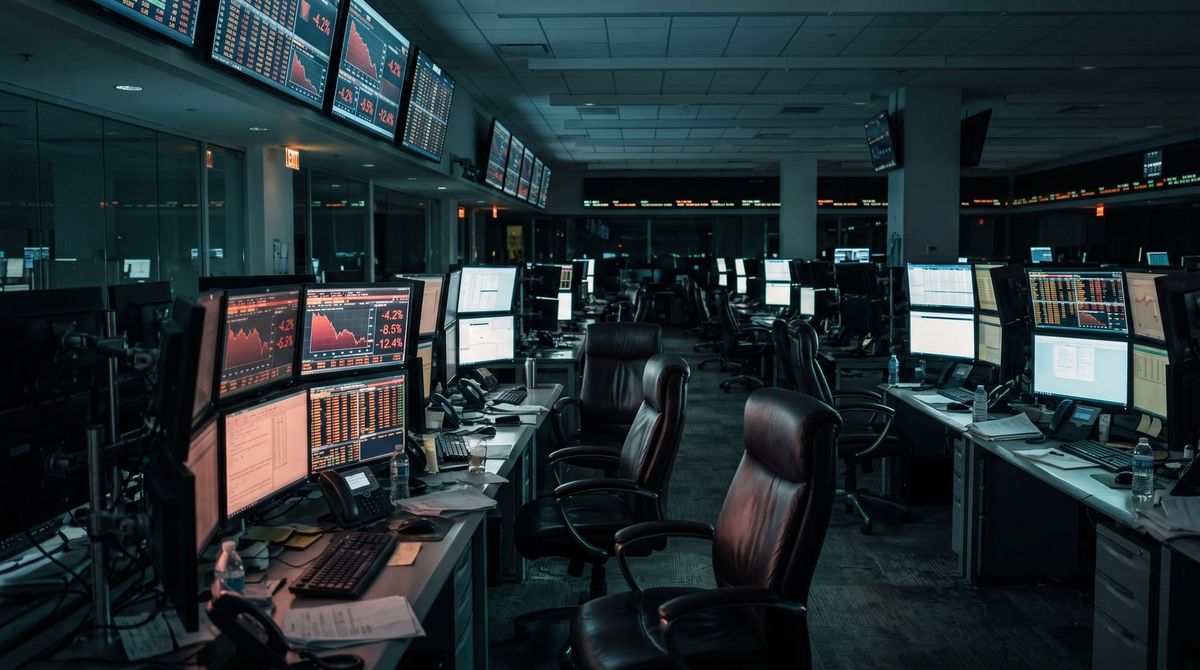
This morning's futures session is erasing most of the week's equity gains in a single pre-market window. Nasdaq-100 futures are down 1.8%. S&P 500 futures are down 1.1%. The proximate cause is a batch of technology earnings that landed below inflated analyst expectations — not catastrophic misses, but misses in a market that had priced perfection. Simultaneously, Brent crude crossed $111 per barrel. Tesla is down approximately 5% as the market reads its capital expenditure reduction not as financial discipline but as a retreat from the robotics and AI buildout. Asia has already processed the same signal: Nikkei 225 closed down 2.4%, Kospi down 2.1%. The Archive is not surprised.
|
|
Flying cars are back in the headlines. Elon Musk is talking about flying cars again, and the whole category is getting a fresh look. But headlines don't fly. Aircraft do. One company has been doing the hard part for years: designing, building, and flight-testing a personal electric aircraft. It started in a South Florida garage with a 3D printer. Today its prototype has completed 70+ manned test flights. It has been building an electric flying car in South Florida since 2019. Two seats. Home outlet charging. Two-car garage fit. |

|
|
Its name is Doroni Aerospace. Its Reg A+ share price is $3.30. October 22 is the last day to invest at that price. Invest in Doroni before October 22 → Doroni is a company running a fully SEC-qualified Reg A+ round:
Right now, you can still invest at $3.30 a share. That window closes October 22. On October 23, the share price changes. Lock in $3.30 before October 22 → Bonus tiers close with this round:
Reserve Your Doroni Shares Before October 22 → |
| This is a paid advertisement for Doroni Regulation A offering. Please read the offering circular at https://invest.doroni.io/ |
| Sponsored |
The Earnings Miss That Was Never a Surprise
What the Analysts Had Priced
Technology earnings expectations entering this week had reached a level that deserved institutional skepticism. The consensus had been extrapolating AI-driven revenue acceleration at a velocity that companies themselves had not guided toward. When earnings landed below those extrapolations — not in disaster, but in measured disappointment — the futures market responded with the only mechanism available to it: price discovery, conducted rapidly and without apology. The Archive's position is not that these companies performed poorly. The Archive's position is that the prior consensus was a construct, and constructs have correction events.
The Structural Vulnerability Beneath the Miss
What the earnings miss reveals is not a technology problem. It is a valuation architecture problem. The Nasdaq-100 had been priced against a rate environment that the Federal Reserve has been methodically dismantling. When the earnings data arrived as the weaker leg of a two-legged argument — the other leg being rate cuts — the combined structure lost cohesion. A 1.8% futures decline in a single pre-market session is not a correction. It is the first sentence of a correction's thesis statement.
Oil at $111 and the Tesla Capex Signal
Brent at $111 Is Not Coincidental
Brent crude crossing $111 this morning is not a supply shock in isolation. It is the second data point in a stagflationary setup that the Archive has been documenting for three weeks. When equity markets sell off on earnings disappointments while simultaneously absorbing a materials inflation signal of this magnitude, the Federal Reserve's path narrows considerably. A rate pause was already the dominant market expectation at 86% probability. Oil at $111 converts that probability into a constraint: the Fed cannot cut into a commodity inflation event without abandoning its own credibility. That combination — frozen policy, rising input costs, deflating equity multiples — is the anatomy of a prolonged compression.
Tesla's Capex Cut as AI Proxy Decline
The Tesla selloff requires separate analysis because the market is reading it correctly for once. A capital expenditure reduction at a company that had positioned robotics and autonomous AI infrastructure as its primary growth narrative is not cost discipline — it is a signal about confidence in the near-term commercial timeline. Investors who bid Tesla up on the premise of Optimus robot deployment and full self-driving monetization are now reading the capex line as management hedging its own forward guidance. The 5% decline in pre-market is a rational Bayesian update. This same dynamic — AI infrastructure capex as the canary — will be visible across other technology names as earnings season progresses.
|
Central banks just broke record books by buying 289 tonnes of gold in a single quarter. Goldman Sachs predicts they'll keep buying another 60 tons more every single month. The world's biggest institutions are quietly abandoning the dollar for gold. But here's the problem: gold bars sat in a bank vault pay $0 in income. While central banks lock up billions in dead metal, smart income investors are using a hidden $15 gold fund to pull real cash out of this rally. No mining stocks. No options trading. Not a single physical bar to store. It's a simple gold strategy yielding up to 46% annually, delivering real Friday cash payouts straight to your account: … $246 … $264 … $273 … $344. It's already turning gold's historic run into up to $1,127 a month in extra spending cash. The next payout is scheduled for this Friday. Click here to see how to collect your first Friday gold payout. |
| Sponsored |
Bait. Friction. Extraction.
The Bait
"Tech earnings disappointed on the top line, but the AI investment thesis is intact." This is the recovery narrative that will circulate through financial media by noon. Analysts will cite forward guidance, management commentary about multi-year infrastructure cycles, and isolated beats within the broader miss. The construction is deliberate: preserve the thesis, discount the data, reset expectations upward for next quarter.
The Friction
The friction point is oil at $111. An AI infrastructure thesis that requires sustained low-cost energy input — data centers, semiconductor fabrication, logistics networks — does not survive intact in a $111 oil environment. It survives with margin compression. It survives with extended payback periods. Simultaneously, Tesla cutting capex is a direct contradiction of the AI buildout narrative. You cannot tell both stories at the same time. The market is discovering that today.
The Extraction
What the Archive extracts: this is not a one-day event. The Asian session has already transmitted the signal — Nikkei down 2.4%, Kospi down 2.1% — which means the institutional capital that rotated into Asia on dollar weakness is now repricing that rotation. The combined effect is a tightening of the global risk premium at precisely the moment when the Federal Reserve cannot provide relief. That is a structural condition, not a pre-market aberration.
"The AI infrastructure thesis does not fail on earnings day. It fails on the day that oil, capex cuts, and rate immobility arrive in the same pre-market session."
— Julian Alden · The Fiduciary Archive
|
Jeff Brown is the former tech executive who called the rise of Bitcoin, Tesla, and Nvidia years in advance. He's now predicting Elon Musk is about to open a new wealth window by October 30. Click here to see the details — the last three times this window opened, those who acted had a chance to walk away with generational wealth. Have you seen this Elon Musk new project? He called it "the most epic AI project in history…" Because it could help him secure 50 times MORE computing power than the entire rest of the world. This is all part of Elon Musk's $320 trillion masterplan — a blueprint to completely dominate the entire AI industry. Elon is predicting this could be 180 times bigger than the SpaceX IPO. That IPO minted 4,400 millionaires overnight. Click here to see the details and decide for yourself. We have so much to look forward to, Jeff Brown Founder & CEO, Brownstone Research |
| Sponsored |
Three Positions for a Stagflationary Compression
Position One
Gold as the Rate-Constrained Reserve
When the Federal Reserve cannot cut rates into a commodity inflation event and cannot raise rates into an equity selloff, gold occupies the only available position: the asset that does not require a policy decision to perform. This morning's confluence adds a sixth structural support to the Archive's thesis: the stagflationary premium. Institutional gold allocation is not a trade. It is the recognition that the policy toolkit has a shorter reach than the market believed.
Position Two
Energy Infrastructure Over Energy Equities
Oil at $111 creates a surface-level case for energy equities. The Archive's position is more precise: the beneficiaries are not the exploration and production companies whose margins are already priced for this level. The beneficiaries are midstream infrastructure assets — pipelines, storage, processing — whose revenue is contractually locked and whose capital requirements are largely sunk. In a high-oil, high-inflation environment, the infrastructure layer outperforms the commodity layer on a risk-adjusted basis.
Position Three
Selective Short Duration on Overvalued AI Names
The Tesla capex signal is generalizable. Any technology company that carried its valuation predominantly on AI infrastructure spending projections — and that has not yet reported this earnings cycle — now carries elevated risk of multiple compression on its own capex disclosure. The Archive does not advocate indiscriminate short positions. The Archive advocates surgical attention to the names where AI capex was the only story, where alternative revenue streams are not yet material, and where the current multiple implies an acceleration the Tesla signal has now called into question.
The market is reading this morning as four separate events: earnings miss, oil spike, Tesla decline, Asia contagion. The Archive reads it as one event — the moment the multiple-compression thesis, the stagflation thesis, and the AI capex credibility thesis converged into a single pre-market session. The simultaneity is not accidental. These forces have been building in parallel. This is what confluence looks like when it arrives.
Gold does not require the market to agree with the Archive. Gold requires the Fed to remain constrained. Oil at $111 ensures that constraint will extend.
THE MATH REMAINS ABSOLUTE.