Eight of the Most Powerful Men in AI Signed a 300-Word "Morally Binding" Document at the White House
Regulatory Theater Audit
Musk, Zuckerberg, Bezos, and Huang Signed a 300-Word "Morally Binding" AI Document at the White House — Speaker Johnson Confirmed It Has No Legal Force
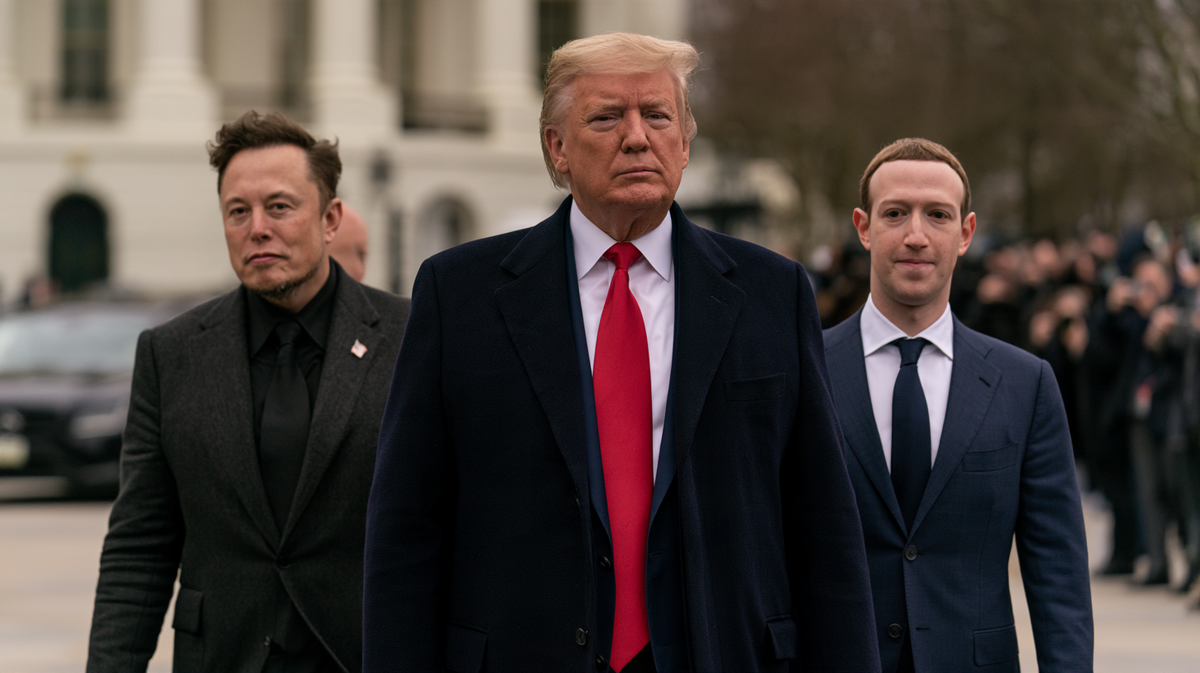
Eight of the most powerful technology executives in the world gathered at the White House to sign the "White House Accord on Super Intelligence" — a voluntary, 300-word document with four self-imposed audit tiers and no legal enforcement mechanism. Trump called it "morally binding" and "almost like a constitution." Speaker Johnson confirmed it carries no legal weight. Trump also announced he is renaming artificial intelligence "superintelligence," a term he and Xi agreed to use jointly during the September 24 summit. A ten-person oversight committee is under discussion. An enforcement adviser will be named "in the coming days." The Archive reads what was signed and what was not.
The signatories: Elon Musk (xAI), Mark Zuckerberg (Meta), Jeff Bezos (Amazon), Jensen Huang (Nvidia), Sundar Pichai (Google), Alex Karp (Palantir), Greg Brockman (OpenAI), and Dario Amodei (Anthropic). The document: approximately 300 words, four voluntary audit tiers, no defined penalties, no regulatory body with authority to enforce, no congressional ratification. Trump's characterization: "morally binding," "almost like a constitution," "colossally self-regulating." Johnson's characterization: no legal force. The Archive's read: eight men who collectively control the most consequential technology in human history have agreed to hold themselves accountable to a document they wrote, with oversight from a committee that has not yet been formed, enforced by an adviser who has not yet been named.
The renaming is the part the Archive reads most carefully. Trump and Xi agreed during the September 24 summit to jointly adopt the term "superintelligence" instead of "artificial intelligence" — a semantic shift with no technical definition attached, announced in the White House fact sheet under "MAKING THE WORLD SAFER FOR AMERICANS" alongside drug enforcement and panda diplomacy. Axios noted it was "not clear what kind of incidents would rise to the level of using" the U.S.-China SI Dialogue channel established at the summit. The domestic accord extends the same terminology — and the same definitional ambiguity — into U.S. regulatory framework. You cannot regulate what you have not defined. The Archive reads the renaming as the document's most consequential feature, and the most honest one: it establishes that the government's primary regulatory contribution to AI governance in September 2026 is a new word.
Fiduciary Recommendation — Ad
|

I.What the Accord Actually Contains — and What the History of Voluntary AI Commitments Predicts
The document: 300 words, four audit tiers, no enforcement.
The "White House Accord on Super Intelligence" contains approximately 300 words — shorter than the Archive's standard lead paragraph — and commits signatories to four tiers of voluntary control and audit. No penalty is specified for non-compliance. No regulatory body has authority to enforce compliance. The oversight committee of ten has not been named. The enforcement adviser has not been named. The document is "morally binding" in Trump's characterization — a legal category that does not exist in U.S. law, which is why Speaker Johnson clarified that it carries no legal force. The Archive reads a 300-word voluntary document signed by eight executives as a press event, not a regulatory framework. The question is not whether the signatories will comply — voluntary commitments from companies that write their own terms are by definition complied with. The question is what the terms actually require and whether they constrain any behavior that would not have occurred anyway.
The 2023 voluntary commitments: the Archive's prior reference case.
In July 2023, seven AI companies — Google, Microsoft, Meta, Amazon, OpenAI, Anthropic, and Inflection — signed voluntary commitments at the White House on AI safety. The commitments included watermarking AI-generated content, sharing safety information with governments, and investing in cybersecurity research. Three years later, mandatory watermarking has not been implemented by most signatories, the information-sharing frameworks produced no publicly documented safety interventions, and Inflection — one of the original signatories — was acquired by Microsoft and dissolved as an independent entity. The voluntary commitment framework produced real internal safety work at several companies. It produced no measurable constraint on AI deployment pace, capability development, or competitive behavior. The 2026 accord follows the same architecture: voluntary, self-defined, self-audited, with a committee to be named and an adviser to be appointed.
Feature
2023 Commitments
2026 Accord
Legal enforcement
None
None
Signatories
7 companies
8 executives
Oversight body
None named
Committee TBD
Deployment constrained?
No
No
Trump characterization
"Historic"
"Almost a Constitution"
New terminology introduced
None
"Superintelligence"
II.Forensic Dissection: Why the Eight Executives Signed Enthusiastically
The Bait
Eight executives signing a voluntary AI accord at the White House produces a set of outcomes each of them values: a presidential photo with "morally binding" language attached to their name, a documented history of cooperation with the administration in the event of future regulatory pressure, a public positioning as responsible stewards of technology rather than unconstrained actors, and — most importantly — the establishment of a self-regulatory framework that substitutes for mandatory regulation. Every week that a voluntary accord exists, the legislative and regulatory clock for mandatory rules runs more slowly. The signatories did not sign because the document constrains them. They signed because it helps ensure that a more constraining document does not replace it.
The Friction
The "morally binding" characterization is the document's most revealing phrase. "Morally binding" is the language deployed when something cannot be made legally binding — either because the political will for legislation does not exist, or because the parties involved would not sign a legally binding version. Trump called it "almost like a constitution" — a document that is the supreme law of the land and legally enforceable in every federal court. An accord that is "almost like" a constitution is, by definition, not a constitution. Speaker Johnson's clarification — no legal force — is the accurate technical description. The gap between "almost like a constitution" and "no legal force" is the entire distance between regulation and a press event. The Archive does not read that gap as a failure of ambition. It reads it as the intended outcome of a process designed to produce the appearance of governance without its constraints.
The Extraction
The extraction for the sovereign investor is the regulatory timeline. The accord signals that binding AI legislation — which would require congressional action, defined penalties, and an enforcement body with actual authority — is not coming before the November 3 midterms, not coming before the January 10 Busan deadline, and not coming before the December lame-duck session. The voluntary accord is what the administration produces when it wants to demonstrate AI governance activity without triggering the industry opposition that mandatory regulation would generate. The AI companies that signed will continue deploying models, acquiring capabilities, and expanding compute at exactly the pace the absence of legal constraints allows. The committee will meet. The adviser will be named. The Archive watches the four audit tiers to determine whether any of them constrain any behavior that would not have been constrained anyway — and will report when it finds one.
Fiduciary Recommendation — Ad
|
"The Archive's rule for reading voluntary tech accords: find the behavior that was going to happen anyway and count how many of the commitments require something that would not have happened without them. The 2023 commitments produced real internal safety work — and zero measurable constraints on deployment pace, competitive behavior, or capability development. The 2026 accord is 300 words signed by the eight most powerful people in AI, in a room with the president, with a committee to be named and an adviser to be appointed. The document is 'morally binding.' Speaker Johnson confirmed it has no legal force. The Archive will watch the four audit tiers. It will report when it finds a commitment that constrains behavior that was not already constrained by market forces, liability concerns, or the companies' own existing safety processes. That is the only sentence in this document the Archive is interested in."
III.The Sovereign Blueprint: What the Accord Actually Changes
The Regulatory Timeline: Binding Legislation Is Not Coming This Year
The accord's clearest market signal is what it replaces: mandatory regulation. A voluntary accord signed by the industry's eight most prominent executives, blessed by the president as "almost a constitution," reduces the political urgency for congressional action. The lame-duck session after November 3 has the Farm Bill, NDAA, the CR deadline, and reconciliation to manage. AI legislation that would require hearings, markup, floor debate, and enforcement rulemaking is not in that queue. The accord's existence is the argument against moving it to the front of the queue. The Archive reads the voluntary accord as a 2027 problem at earliest for mandatory AI governance — and that timeline assumes a Congress with the composition and appetite to pursue it.
The Renaming Is the Only Concrete Output — and It Already Has a Diplomatic Dimension
Trump and Xi agreed at the September 24 summit to use the term "superintelligence" in bilateral AI communications. The domestic accord extends that terminology to U.S. industry. The renaming is not semantic vanity — it is a diplomatic alignment signal that the U.S. and China are operating from a shared vocabulary, which is the precondition for the U.S.-China SI Dialogue established at the summit to function. The Archive reads the renaming as the accord's most consequential concrete output: it advances the diplomatic AI governance channel with China while simultaneously establishing the administration's preferred terminology for domestic regulation. A word that is used in both U.S.-China bilateral documents and U.S. domestic regulatory frameworks is the beginning of a definitional standard. Whether that standard produces substantive governance depends entirely on what definitions get attached to the word — which the accord does not specify.
Watch the Ten-Person Committee — That Is Where Actual Governance Would Live
The accord's operational mechanism is the committee of ten, which has not yet been formed, and the enforcement adviser, who has not yet been named. The Archive's watch list: who are the ten members, and how many of them are employed by or financially connected to the companies that signed the accord? A committee of ten that includes representatives from Anthropic, OpenAI, Nvidia, and Meta is an industry working group with a government letterhead. A committee of ten that includes independent researchers, civil society representatives, and government officials with enforcement authority is something different. The committee composition is the only variable in the accord's architecture that could convert a press event into a governance mechanism. The Archive will report when the names are announced.
300 words. Four voluntary audit tiers. No legal force — confirmed by Speaker Johnson. Eight signatures from the eight most powerful executives in AI. A committee to be named. An adviser to be appointed. A new word: "superintelligence," now shared with Xi, now applied domestically. The Archive reads the accord as a press event with diplomatic utility attached. The regulatory timeline for mandatory AI governance extends. The deployment pace of the eight signatories does not change. The committee composition, when announced, is the only variable that could make the Archive revise that read.
THE MATH REMAINS ABSOLUTE.