
China Just Blinked — and Two Months Instead of Six Is the Most Honest Answer Xi Brought to Washington.
Geopolitical Capital Audit — Day Two
The Summit That Delivered Two Months Instead of Six — and What Bessent's "More Deliverables" Language Actually Means for the Trade and Iran Tracks
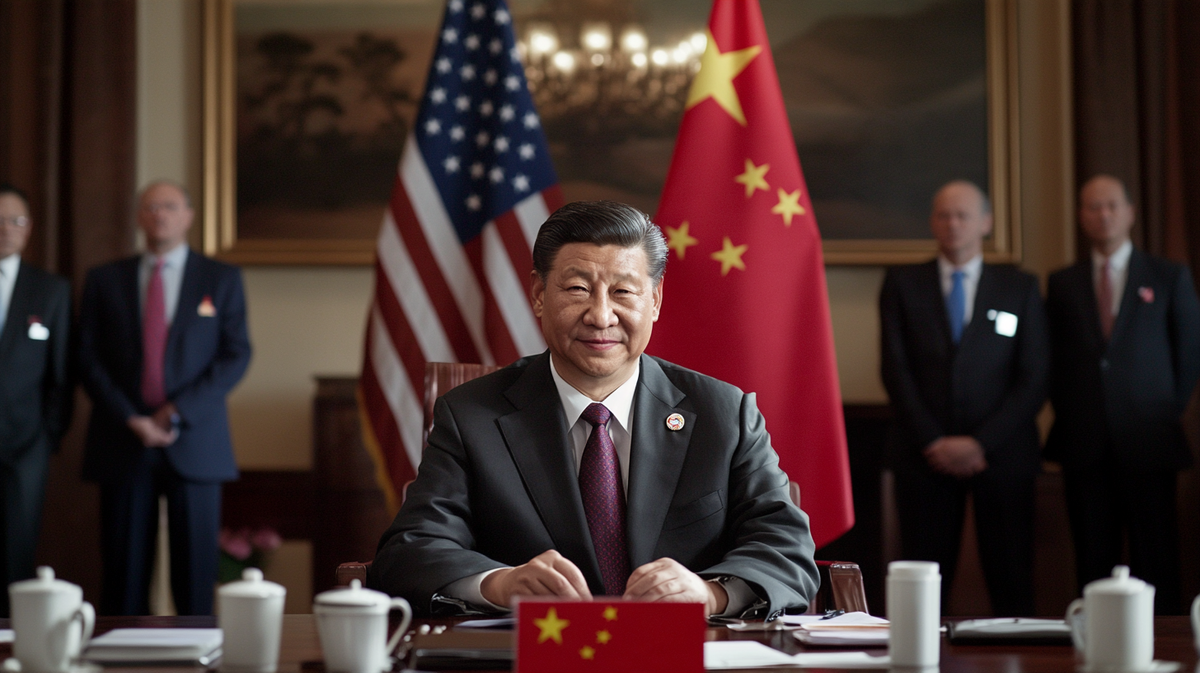
Xi landed at Andrews Wednesday evening. Trump and Melania met him on the tarmac — the first time an American president has met a foreign leader at the airfield in eleven years. Today: South Lawn ceremony, Rose Garden military review, Oval Office bilateral at 11:30 AM, expanded session at noon. The pre-summit deliverable already landed: Bessent confirmed Wednesday that the Busan Agreement is extended to January 10 — two months, not the six or more that markets expected. CSIS analyst Scott Kennedy read it plainly: the short extension means the U.S. is unsatisfied with China's offers and wants to keep the pressure on. The Archive reads both the ceremony and the signal.
Treasury Secretary Scott Bessent said Wednesday that the U.S. and China have agreed to extend their bilateral trade truce through Jan. 10. "We will extend what we call the 'Busan Agreement' — the economic détente between the two countries that was scheduled to end on Nov. 10 — that is going to be extended until Jan. 10," Bessent said on Fox News. The announcement came after Bessent met with Chinese Vice Premier He Lifeng in an unscheduled meeting ahead of Xi's arrival. Bessent indicated Beijing needs to fulfill more deliverables. The two sides also discussed setting up an alert system for AI incidents. Many had expected the truce to be extended by six months or longer.
The two-month extension "suggests to me the U.S. is unsatisfied with China's offers and wants to keep the heat on, with a bonus being it is more likely that Xi goes to the G20 in Miami," said Scott Kennedy of CSIS. While executives of major U.S. tech companies plan to join a summit dinner on Thursday, none of their Chinese counterparts are expected to attend. Politburo Standing Committee Member Cai Qi and China's top diplomat Wang Yi accompanied Xi, according to state media. Chinese state media did not immediately note Bessent's comments on the trade truce. The Archive reads the Chinese state media silence as the diplomatic tell: Beijing received the two-month extension as a message, not a gift, and has not yet decided how to characterize it publicly.
Yesterday the Archive wrote that the tarmac welcome was the operational signal and "we don't need China's help" was the public posture. The pre-summit Bessent-He Lifeng meeting confirms the operational reality: the two sides are negotiating actively, there is a gap between what China has offered and what Washington wants, and the two-month extension is the lever Washington is using to keep that gap productive rather than closing it prematurely. The January 10 date is not arbitrary — it lands after the November 3 midterms, after whatever the post-election war posture produces, and before the G20 in Miami that Kennedy referenced. The Archive reads the January 10 deadline as the three-event sequencer: midterms → war posture → G20. China is being told to wait and see what November produces before a larger deal becomes possible.
Fiduciary Recommendation — Ad
|
I.What the Two-Month Extension Actually Signals
The Busan Agreement: what it was and what it preserved.
Trump and Xi agreed to a one-year trade truce at their meeting in South Korea in October 2025. The U.S. reduced tariffs on Chinese exports from 57% to 47%, while China agreed to suspend its most recent export controls on rare earth metals for one year. As part of the agreement, the U.S. postponed fees on Chinese ships arriving at U.S. ports and China agreed to buy "large quantities" of U.S. agricultural products. That was the deal signed eleven months ago. The deal, which was set to expire in November, will now be extended to Jan. 10, Bessent said, noting the need for Beijing to fulfill more deliverables. The rare earth suspension — which prevented the reimposition of Chinese export controls that would have disrupted defense manufacturing, EV battery production, and semiconductor supply chains — is now extended two months. Not twelve. Not six. Two.
The gap between two months and six months is the negotiating map.
Markets expected six months or longer. Kennedy's read — two months means Washington is unsatisfied with China's offers — is the Archive's read too. Bessent also indicated there could be further announcements in coming days from the Chinese delegation, including agreements to buy more American agricultural products and potential deals in the financial services sector. "Further announcements in coming days" is the language of a negotiation that is ongoing rather than concluded. The Oval Office bilateral this morning is not the end of the Busan extension conversation — it is the next round. January 10 is when the next round's outcome is priced into supply chains.
What the Extension Preserves
Tariffs held at 47% not 57%. Chinese rare earth export controls suspended. U.S. port fees on Chinese ships deferred. Agricultural purchase commitments active. No supply chain shock before January 10.
What the Two Months Signal
Beijing's offers were insufficient for a 6-month deal. Washington is keeping pressure on. January 10 sequences after November 3 midterms and the post-election war posture shift. China is being asked to wait for November's outcome before a larger deal is possible.
Chinese state media silence is the most important signal in the room.
Chinese state media did not immediately note Bessent's comments on the trade truce. In Chinese diplomatic practice, state media silence on a foreign official's announcement about bilateral negotiations means Beijing has not yet decided how to characterize the outcome — which means the outcome is not what Beijing expected or wanted to communicate publicly. A six-month extension would have been characterized as a Chinese diplomatic achievement: stability, continuity, mutual benefit. A two-month extension with "more deliverables" language is harder to frame as an achievement. The silence is Beijing deciding whether to call it a win, a setback, or a work in progress. The Archive reads the silence as a setback being processed.
II.Forensic Dissection: The Ceremony That Is Real and the Deal That Is Not
The Bait
The tarmac welcome, the South Lawn ceremony, the Rose Garden military review, the state dinner, the Oval Office bilateral — these are the most complete state visit protocols the Trump administration has extended to any foreign leader. They communicate that the bilateral relationship is being managed at the leader level with full ceremonial respect. The Busan extension — even at two months — prevents the supply chain disruption that would follow from tariffs reverting to 57% or rare earth controls reimposing. Agricultural purchases and financial services sector agreements may follow from the summit's conversations. The relationship is stable, actively managed, and producing sequential outcomes. That is not nothing.
The Friction
The May Beijing summit produced rare earth commitments, agricultural purchase pledges, and a bilateral Board of Trade — none of which were implemented by September. The pattern of this bilateral relationship is: ceremonially warm summits producing framework agreements that are not implemented before the next summit reopens the same questions. The two-month Busan extension is the third iteration of this pattern: Busan (October 2025) → Beijing (May 2026) → Washington (September 2026). Each summit produces a time-limited framework that does not resolve the structural disagreements beneath it. The January 10 date produces a fourth summit or a breakdown. The Archive reads the two-month extension not as a deal — it is a deadline. Experts say it's unlikely this week's summit will produce any major security agreement on AI. Relations have been at an effective standstill, with both sides buying time to reinforce their strengths and address their vulnerabilities. That sentence from NBC applies equally to trade, rare earths, Iran, and satellite imagery.
The Extraction
The extraction from today's summit is not a trade position — it is a sequencing calendar. January 10 is six days after Congress reconvenes following the November 3 midterms. It is after the post-election war posture shift Trump has telegraphed. It is before the G20 in Miami. The January 10 Busan deadline sequences with those three events in a way that six months would not have: a six-month extension takes the trade question off the table through April, removing the leverage that Washington is using to push Beijing on Iran, satellite imagery, and the remaining Busan deliverables. Two months keeps that leverage active through the most consequential diplomatic window of the cycle. The Archive reads January 10 not as an arbitrary calendar date — it reads it as the deadline Washington set knowing exactly what sequence of events precedes it.
"The Archive told you yesterday to watch the tarmac welcome and read it as the operational signal, not 'we don't need China's help' as the policy. Wednesday confirmed that read: Bessent met He Lifeng in an unscheduled meeting before Xi's plane landed, announced a two-month extension with 'more deliverables' language, and signaled additional announcements in coming days. That is not the behavior of two sides that don't need each other. It is the behavior of two sides in an active negotiation managing the optics of mutual leverage. The state dinner happens tonight. The communiqué drops after. The Archive reads the January 10 deadline as the most consequential sentence in today's documents — more consequential than anything the ceremony produces."
III.The Sovereign Blueprint: Three Positions After the Oval Office Bilateral
Read the Communiqué for Hormuz and Rare Earth Language Tonight
The Archive's priority read from yesterday holds: Hormuz language first, rare earths second, satellite imagery third, tariffs last. The two-month Busan extension already priced in the tariff outcome — neutral, no supply chain shock, deadline set. What the communiqué adds is whether China offered anything concrete on Iran beyond the trade track. Any joint statement language on "freedom of navigation" in Hormuz, any reference to the conditions for strait reopening, or any language on Iranian nuclear negotiations that goes beyond prior joint positions is the signal that the summit produced something on the war track that the Busan extension did not. Absence of Hormuz language prices the Iran track as unresolved through the pre-election window.
January 10 Is the Rare Earth Supply Chain Clock — Start Watching It Now
The rare earth suspension from Busan is extended to January 10. After that date, if no new agreement is reached, Chinese export controls on rare earth metals reimpose automatically. Rare earths are inputs for defense manufacturing, EV battery production, wind turbine magnets, and semiconductor processing. The supply chain impact of reimposed controls takes approximately 60–90 days to appear in production data — meaning a January 10 breakdown produces visible manufacturing disruption in March and April 2027. The Archive begins tracking the January 10 rare earth clock as a supply chain risk input from today. Any company with significant rare earth exposure in its production inputs has a January 10 deadline to hedge or secure alternative sourcing.
Watch the Post-Summit OFAC List — The Satellite Imagery Question Has Not Gone Away
The WSJ satellite imagery report — Chinese entities provided targeting data for the July 17 Jordan base attack that killed three Americans — is embedded in the summit regardless of whether it appears in the communiqué. The archive's post-summit signal from the September 11 briefing remains: watch the OFAC sanctions list in the 30 days after the summit. Additional sanctions on Chinese imagery firms signals Washington received no satisfactory private assurance from Xi on the imagery question. No additional sanctions signals that China offered something private that changed the trajectory. The state dinner tonight is where that private assurance would be conveyed — which is why the evening's communiqué language is more important than anything said at the Oval Office press availability this morning.
Xi is in the White House today. The Busan Agreement is extended two months — not six. Bessent said Beijing needs to fulfill more deliverables. Chinese state media said nothing. The Archive told you yesterday the tarmac welcome was the operational signal. Wednesday confirmed it: the two sides are actively negotiating, the gap is real, and the two-month deadline sequences exactly with the November 3 midterms, the post-election war posture shift, and the G20 in Miami. Watch the communiqué tonight. Read the Hormuz paragraph first. The January 10 rare earth clock starts now.
THE MATH REMAINS ABSOLUTE.